
Introduction
Artificial intelligence has changed the way people write, study, work, and create content.
AI writing tools can now produce articles, essays, emails, reports, stories, product descriptions, social media posts, and even computer code within seconds. As AI-generated content has become more common, another type of technology has grown alongside it: the AI detector.
An AI detector is designed to analyze written content and estimate whether it was likely produced by an artificial intelligence system rather than written entirely by a person.
You may have seen tools that give results such as:
“AI probability: 85%”
or:
“Likely AI-generated.”
But what does that percentage actually mean?
Can an AI detector really know who wrote a piece of content?
Is an AI detector accurate?
Can human-written content be incorrectly identified as AI?
Can AI-generated content be missed?
And perhaps most importantly, should an AI detector score be treated as proof?
The answer to that last question is generally no.
Modern research shows that AI detection is an imperfect classification problem. Detector performance can vary depending on the model used, the length and type of writing, whether the text has been edited, and the decision threshold used. A September 2026 study evaluating five detection tools specifically found that detector outputs require contextual interpretation rather than being treated as a simple yes-or-no judgment.
This guide explains everything you need to know about AI detectors, including how they work, what they analyze, why they sometimes get things wrong, and how they should be used responsibly.
What Is an AI Detector?
An AI detector is software that analyzes text and estimates whether the text resembles writing generated by an artificial intelligence model.
It does not normally find a secret label hidden inside an AI-written paragraph.
Instead, the detector examines characteristics of the writing.
Depending on the system, these characteristics can include:
- Word selection
- Sentence structure
- Sentence-length variation
- Predictability of wording
- Repetition
- Writing patterns
- Vocabulary distribution
- Statistical characteristics
- Patterns learned from human and AI-written examples
The detector then combines these signals and produces a classification or probability-like score.
For example:
AI probability: 72%
This should not automatically be interpreted as:
“There is a 72% chance that this exact text was written by AI.”
The meaning of a detector score depends on the particular tool, its model, its calibration, and the threshold being used.
That distinction is extremely important.
How Does an AI Detector Work?
The exact technology differs between companies, and commercial detectors generally do not reveal every detail of their systems.
However, the basic concept is easier to understand.
An AI detector is typically trained or designed to distinguish between patterns found in human-written and machine-generated text.
A simplified process looks like this:
Written Content
       ↓
Text Processing
       ↓
Feature Analysis
       ↓
AI Detection Model
       ↓
Probability / Classification
       ↓
Detection Result
Let’s look at each stage.
1. The Detector Receives Your Text
First, you paste or upload the content.
For example:
Artificial intelligence is changing the way businesses operate. Companies are increasingly using AI to automate repetitive tasks and analyze large amounts of information.
The detector processes the text and prepares it for analysis.
The longer the sample, the more information a detector generally has available to analyze. Very short text can be especially difficult because there may not be enough writing characteristics to make a reliable classification.
2. The Text Is Broken Into Smaller Units
A detector doesn’t necessarily treat an article as one giant block.
It can analyze:
- Words
- Sentences
- Paragraphs
- Sentence patterns
- Relationships between words
Modern language models operate with smaller units called tokens, although different detection systems can process text in different ways.
The purpose is to find statistical and linguistic patterns.
3. The Detector Looks at Predictability
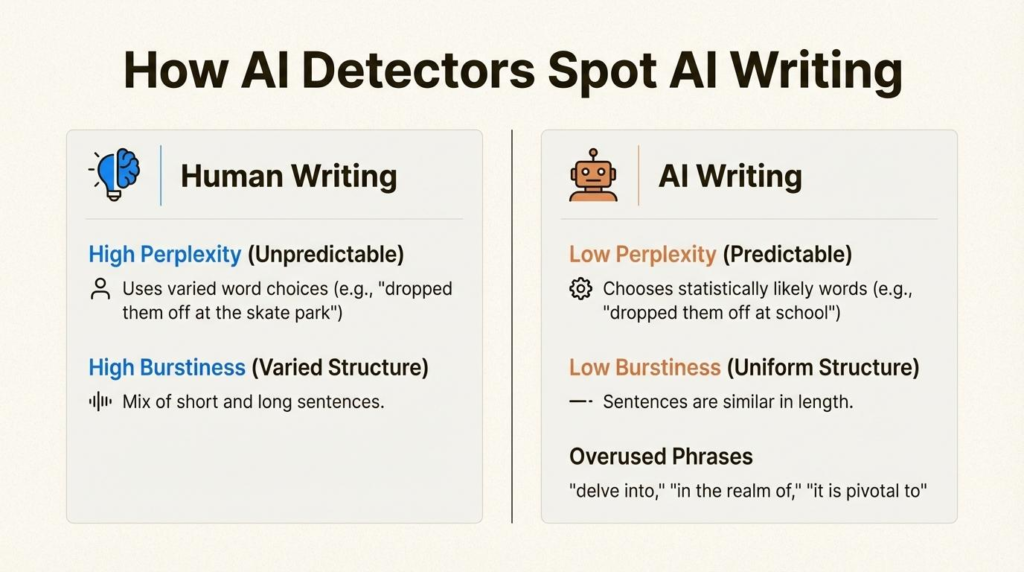
One concept associated with AI text detection is perplexity.
In simple terms, perplexity relates to how predictable the next word in a sequence is according to a language model.
Consider two sentences.
Example A
The cat sat on the mat.
This is a very predictable sentence.
After seeing:
“The cat sat on the…”
many common completions are possible, but “mat” is an unsurprising choice.
Example B
The cat abandoned the garden because Tuesday suddenly smelled metallic.
This is more unusual and less predictable.
Older and simpler AI-detection approaches often used statistical measures related to predictability as one signal.
However, modern AI detectors are generally more sophisticated than simply checking whether text is predictable.
4. Sentence Variation Can Also Matter
Another commonly discussed concept is burstiness.
Burstiness describes variation in sentence structure, length, and predictability.
Human writing can naturally vary:
The experiment failed.
Then a much longer sentence might follow with several clauses explaining why the researchers believe the unexpected result occurred and what they plan to change next time.
AI-generated writing can sometimes have more consistent sentence structures.
For example:
AI is changing education.
AI is changing healthcare.
AI is changing business.
AI is changing entertainment.
A detector may notice patterns like these.
However, this is not proof of AI authorship.
Humans can naturally write in repetitive patterns, while AI can produce highly varied writing.
5. AI Detectors Use Machine Learning
Modern AI detectors can use machine-learning classifiers trained using examples of human-written and AI-generated text.
The basic idea is:
Human Examples ─────┐
                    │
                    ↓
              Detection Model
                    ↑
                    │
AI Examples ────────┘
During development, the system learns statistical differences between its training examples.
When new text is submitted, the detector compares the new sample against patterns it has learned.
This is similar to many other classification systems.
For example:
Spam detector:
Is this email spam or legitimate?
AI detector:
Does this writing resemble AI-generated text or human-written text?
But classification is not the same thing as certainty.
6. The Detector Produces a Score
After analyzing the content, the tool usually produces a result.
Depending on the product, it might show:
- AI-generated percentage
- Human-written percentage
- Probability score
- Classification
- Highlighted sections
- Sentence-level predictions
For example:
AI-generated: 68%
A common mistake is assuming this means the detector has identified exactly 68% of the sentences as AI-generated.
That may not be what the number represents.
The score is generally an output of the detector’s classification system and should be interpreted according to that specific product’s methodology.
Why Can AI Detectors Be Wrong?
This is one of the most important parts of understanding AI detection.
AI detectors can produce both false positives and false negatives.
False positive
Human-written text is incorrectly classified as AI-generated.
False negative
AI-generated text is incorrectly classified as human-written.
Research has repeatedly found these limitations.
A 2023 study testing multiple AI detection tools found that the tools could produce both false positives and false negatives, with overall accuracy varying substantially between systems.
More recent research shows that detector performance has improved in some settings, but results still depend heavily on the type of text being tested. A 2026 study found that performance declined when text included hybrid human-AI writing or substantial human editing.
Why Human Writing Can Be Flagged as AI
Imagine someone writes:
Artificial intelligence is transforming modern business by improving productivity, reducing repetitive work, and helping organizations make better decisions.
There is nothing inherently “AI” about that sentence.
It is simply formal and predictable.
A detector could nevertheless decide that the writing resembles AI-generated language.
This can happen because AI detectors do not have access to a magical record showing who physically typed each sentence.
They analyze the characteristics of the text.
That means a polished human writer can sometimes produce text that resembles patterns common in AI-generated writing.
Non-Native English Writers Can Face Additional Problems
Another important concern is potential bias.
Research has reported that AI detectors can incorrectly flag writing from non-native English speakers as AI-generated.
A 2026 review presented at the American Academy of Neurology noted evidence of misclassification affecting non-native English writing and emphasized that detector results should not be treated as definitive evidence of authorship.
This makes sense when you consider how detection models work.
If a person’s writing uses:
- Simple vocabulary
- Repeated sentence structures
- Formal grammar
- Common phrases
- Limited stylistic variation
the writing might resemble patterns that a detector associates with AI.
But that doesn’t mean the writer used AI.
This is one reason detector scores should be interpreted carefully, especially in high-stakes situations.
Can AI Detectors Detect ChatGPT?
Many AI detectors are designed to identify patterns associated with text produced by large language models such as ChatGPT.
Some tools also claim to detect outputs from other systems, including:
- Gemini
- Claude
- Microsoft Copilot
- Other large language models
However, detection is not guaranteed.
Different models produce different writing patterns.
Models also change over time.
A detector trained or calibrated on one generation of AI writing may not perform identically on a newer generation.
This creates a continuing technological competition between AI generation and AI detection.
AI Detector vs Plagiarism Checker
These two technologies are often confused.
They are not the same thing.
AI Detector
Attempts to estimate whether text resembles AI-generated writing.
Plagiarism Checker
Looks for similarities between submitted text and existing sources.
For example:
AI detector:
“Does this writing resemble AI-generated content?”
Plagiarism checker:
“Does this writing match content that already exists somewhere else?”
A piece of AI-generated text can be completely original and contain no direct copied passages.
Therefore:
AI-generated does not automatically mean plagiarized.
Likewise:
Human-written does not automatically mean original.
Someone can manually copy another person’s article.
AI Detector vs AI Content Checker
The terms are often used interchangeably.
An AI content detector, AI writing detector, AI text detector, and AI detector can all refer to tools that estimate whether written content was generated or heavily assisted by AI.
The exact features vary between products.
Some tools provide only an overall score.
Others provide:
- Sentence-level highlighting
- Confidence scores
- AI probability
- Plagiarism checking
- Grammar checking
- Writing analysis
- Source matching
Are AI Detectors 100% Accurate?
No.
There is no universal AI detector that should be treated as a perfect authorship test.
This is supported by multiple studies.
One study published in 2025 found that AI-output detectors could distinguish human and AI-generated text reasonably well under certain controlled conditions, but none of the tested systems achieved perfect reliability.
A 2026 study similarly emphasized that detector scores should be interpreted as evidence requiring context rather than as a binary verdict.
Therefore, a result such as:
AI detected: 90%
does not mean:
Proof: AI wrote this.
It means the detector’s model considers the text strongly similar to patterns it associates with AI-generated content.
Those are two very different statements.
Why AI Detection Is Becoming More Difficult
AI-generated writing is changing rapidly.
Early language models often produced writing with recognizable characteristics.
Modern models can generate more varied and context-sensitive text.
At the same time, people frequently edit AI-generated drafts.
This creates a spectrum:
100% Human
     ↓
Human + AI Brainstorming
     ↓
Human + AI Editing
     ↓
Human + AI Rewriting
     ↓
AI Draft + Human Editing
     ↓
Mostly AI
     ↓
100% AI
Where exactly should an AI detector draw the line?
That is a difficult technical and philosophical problem.
Recent research specifically found that detection performance can fall for hybrid and humanized text, demonstrating why a simple AI/human binary can be misleading.
Does Editing AI Text Make Detection Impossible?
There is no reliable rule saying that a particular editing method will make text “undetectable.”
What research does show is that human editing can change the characteristics on which detectors rely, which can reduce detection performance.
This is another reason not to treat a detector score as proof of authorship.
The relationship between AI generation and detection is continuously changing.
Should You Trust an AI Detector Score?
You can use an AI detector as one signal, but it should not automatically be treated as a final judgment.
A better approach is to consider additional evidence.
For example, in an educational setting, useful evidence might include:
- Earlier drafts
- Writing history
- Revision history
- Notes
- References
- Previous writing samples
- Student explanations
- The student’s ability to discuss the work
In a publishing environment, you might consider:
- Draft history
- Source material
- Editorial records
- Author documentation
- Revision history
- Disclosure policies
A 2026 study of AI detection in higher education concluded that detectors can provide useful initial flags but should not be used as the sole evidence in high-stakes decisions.
Can Google Detect AI Content?
This question is especially important for website owners.
Google’s published Search guidance does not say that simply using AI to create content automatically makes a page ineligible for search.
Instead, Google’s spam policies focus on whether content is created primarily to manipulate search rankings or whether it provides little or no value to users.
Google specifically identifies scaled content abuse as generating many pages primarily to manipulate search rankings, including using generative AI when the result provides little value.
That means website owners should not think:
“AI content = automatic Google penalty.”
The more useful question is:
Does the page genuinely help the reader?
AI Content Can Still Be Good Content
Using AI as part of the writing process does not automatically make an article useless.
The quality of the final article depends on factors such as:
- Originality
- Accuracy
- Expertise
- Research
- Examples
- First-hand experience
- Clear explanations
- Useful formatting
- Fact checking
- Editorial review
For example, an AI-assisted article that simply rewrites information already available on hundreds of websites may provide little value.
On the other hand, an AI-assisted article that contains original research, expert commentary, useful examples, testing, and genuinely helpful information can provide substantial value.
Google’s current guidance emphasizes the value provided to users rather than treating AI generation itself as the sole criterion.
How to Use an AI Detector for Website Content
If you’re a blogger or website owner, an AI detector can be used as part of your editorial process.
A sensible workflow is:
Step 1: Write or generate the initial draft
Create the article using your normal workflow.
Step 2: Fact-check it
Verify:
- Statistics
- Dates
- Names
- Quotes
- Product specifications
- Scientific claims
- Links
Step 3: Add original value
Add:
- Your own examples
- Personal experience
- Original analysis
- Screenshots
- Testing
- Comparisons
- Expert commentary
Step 4: Edit for readers
Make the article clear and useful.
Step 5: Run an AI detector if you want an additional signal
Treat the result as an indicator rather than a verdict.
Step 6: Review the article yourself
Ask:
Would a real reader find this useful?
That is much more important than chasing a particular detector percentage.
Should You Try to Get a 0% AI Score?
This is a common mistake.
People sometimes become obsessed with getting an AI detector to report:
0% AI
But that isn’t necessarily a meaningful quality goal.
A detector score is not the same thing as:
- Writing quality
- Originality
- Accuracy
- Expertise
- Usefulness
- Search quality
Trying to optimize every sentence specifically to satisfy a detector can actually make the writing worse.
A better goal is:
Create accurate, original, useful content for humans.
If AI was used during the process, follow the disclosure or usage rules that apply to your particular context.
How to Make AI-Assisted Content Better
If you’re using AI to help with an article, focus on improving the substance, not simply changing wording to influence detector results.
Add genuine value such as:
Original research
Collect information that isn’t simply copied from existing articles.
Personal experience
Explain what you actually tested or observed.
Expert insight
Include information from qualified people or authoritative sources.
Examples
Show readers how something works in real situations.
Data
Use trustworthy statistics and explain what they mean.
Comparisons
Help readers understand the differences between products, methods, or technologies.
Clear explanations
Don’t use complicated language just to make an article appear sophisticated.
Good writing is about communication, not complexity.
Why AI Detectors Should Not Be Used as a Lie Detector
An AI detector does not know what happened when the article was written.
It does not see:
- Who typed each sentence
- Who edited the paragraph
- What the writer was thinking
- Whether the author used a grammar checker
- Whether a sentence was rewritten several times
- Whether multiple people collaborated
It sees the final text.
Then it makes an inference.
That means:
Detector result = statistical assessment
not:
Detector result = historical proof of authorship
This distinction becomes especially important when consequences are serious.
What Is a False Positive?
A false positive occurs when a detector says:
“This looks AI-generated.”
but the content was actually written by a human.
For example:
Actual authorship:
Human

Detector:
AI

Result:
False positive
False positives can be particularly problematic in schools, universities, workplaces, and publishing because an incorrect accusation can have real consequences.
What Is a False Negative?
A false negative is the opposite.
Actual authorship:
AI

Detector:
Human

Result:
False negative
This can happen because the detector fails to recognize the patterns in the generated content.
Studies have documented both types of errors.
Why Different AI Detectors Give Different Results
You may put the same article into several detectors and receive:
Detector A: 15% AI
Detector B: 48% AI
Detector C: 82% AI
Why?
Because they may use:
- Different training data
- Different models
- Different features
- Different thresholds
- Different definitions of AI-like writing
- Different calibration methods
There is no universal “AI meter” shared by every detector.
Each detector is making its own statistical assessment.
Should You Use Multiple AI Detectors?
Using more than one detector can provide additional information, but it doesn’t magically produce certainty.
If three detectors agree, that may increase confidence that the text deserves closer review.
But disagreement can also be informative.
For example:
Detector A → 10%
Detector B → 52%
Detector C → 81%
This tells you that the classification is uncertain or that the systems are measuring different things.
The correct response should not automatically be:
“The highest number must be correct.”
Instead, investigate the underlying evidence.
The Future of AI Detection
AI detection will probably continue evolving as AI generation improves.
Future systems may combine more signals, including:
- Text analysis
- Metadata
- Provenance
- Watermarking
- Document history
- Authorship records
- Content fingerprints
This is important because text-only detection has fundamental limitations.
A more reliable future may involve provenance—information about where content came from and how it was created—rather than trying to guess authorship from writing style alone.
AI Detection Is Becoming an Arms Race
There is an ongoing cycle:
AI generators improve
        ↓
AI-generated writing becomes more varied
        ↓
Detectors improve
        ↓
Generators change
        ↓
Detectors adapt
        ↓
The cycle continues
This is one reason no detector should be considered permanently perfect.
The technology being detected is constantly changing.
Recent research has described this as an evolving “arms race” in which human editing and newer generation techniques can reduce detector sensitivity.
The Best Way to Think About AI Detectors
The simplest way to understand an AI detector is:
It is an estimation tool, not a mind reader.
It examines text and asks:
“How similar is this writing to patterns associated with AI-generated content?”
It does not directly observe the writing process.
That distinction explains almost every major limitation of AI detection.
Frequently Asked Questions About AI Detectors
What is an AI detector?
An AI detector is software that analyzes text and estimates whether it resembles content generated by artificial intelligence.
How does an AI detector work?
AI detectors analyze linguistic and statistical patterns such as word choice, sentence structure, predictability, and other characteristics. More advanced systems use machine-learning classifiers trained on human and AI-generated examples.
Are AI detectors accurate?
They can perform well in some controlled situations, but they are not perfectly reliable. Performance can vary by text type, AI model, editing, language, and detection threshold.
Can AI detectors detect ChatGPT?
Many detectors are designed to identify text that resembles output from systems such as ChatGPT, but detection is not guaranteed.
Can human writing be detected as AI?
Yes. This is called a false positive. Research has documented cases where human writing is incorrectly classified as AI-generated.
Can AI-generated writing be detected as human?
Yes. This is called a false negative. AI detection systems can miss AI-generated text.
Is an AI detector the same as a plagiarism checker?
No. A plagiarism checker looks for similarities with existing sources, while an AI detector estimates whether writing resembles AI-generated content.
Does Google automatically penalize AI-written content?
Google’s published guidance does not say that AI-generated content is automatically penalized simply because AI was used. Its spam policies focus on content created primarily to manipulate search rankings, including scaled content that provides little or no value to users.
Should an AI detector score be treated as proof?
No. Especially in high-stakes situations, the score should be considered alongside other evidence rather than treated as definitive proof of authorship.
Why do AI detectors sometimes disagree?
Different detectors use different models, training data, signals, thresholds, and methodologies. Therefore, the same article can receive different scores from different tools.
What is the best way to use an AI detector?
Use it as one editorial or screening signal. Combine the result with source checking, revision history, human review, and other relevant evidence.
Final Thoughts
AI detectors have become increasingly important as generative AI becomes part of everyday writing.
They can be useful.
They can identify patterns that may deserve closer examination.
But they are not perfect authorship machines.
A percentage shown on a screen cannot tell the complete story of how an article was created.
Human writing can be flagged as AI.
AI writing can be missed.
Hybrid writing can be particularly difficult to classify.
And different detection tools can reach different conclusions about exactly the same text. Recent research continues to show that detector scores need context and should not automatically be treated as binary proof.
For website owners, writers, teachers, students, publishers, and businesses, the smartest approach is therefore not to ask only:
“What percentage of this article is AI?”
Instead, ask:
“Is this content accurate, original, useful, properly sourced, and appropriate for its intended audience?”
That is a much more meaningful standard.
As AI becomes better at generating text, the future of content evaluation will likely depend less on a single detector score and more on a combination of quality, provenance, transparency, human judgment, and trustworthy evidence.
And that is why understanding what an AI detector can—and cannot—actually tell you is more important than simply knowing what number it displays.