
Artificial intelligence, better known as AI, has quickly become part of everyday life. You may use AI when asking a chatbot a question, unlocking your phone with your face, watching recommendations on YouTube, getting directions from a navigation app, filtering spam emails, or generating an image from a text description.
But have you ever wondered how AI actually works?
AI can sometimes appear almost magical because it can understand language, recognize objects, generate images, write code, analyze information and make predictions. In reality, however, AI works through a combination of data, algorithms, mathematical models, computing power and training.
The basic idea is surprisingly simple: an AI system is given information, learns patterns from that information, and then uses those learned patterns to produce predictions, classifications, recommendations or generated content.
This guide explains how AI works from beginning to end, including machine learning, neural networks, deep learning, generative AI, large language models and AI training.
What Is Artificial Intelligence?
Artificial intelligence is a broad field of computer science focused on creating computer systems that can perform tasks that normally require some form of human intelligence.
These tasks can include:
- Understanding language
- Recognizing images
- Identifying speech
- Finding patterns in data
- Making predictions
- Recommending products or videos
- Translating languages
- Generating text and images
- Solving certain problems
- Controlling machines and robots
AI isn’t one single program or technology. It is an umbrella term covering many different approaches.
For example, a spam filter, a recommendation system, a self-driving system and a chatbot can all use AI, but they may use very different models and techniques.
The relationship can be simplified like this:
Artificial Intelligence → Machine Learning → Deep Learning → Neural Networks → Modern Generative AI
Machine learning is a subset of AI, while deep learning is a subset of machine learning. Modern generative AI commonly uses deep-learning architectures such as transformers and diffusion models.
How Does AI Work?
At a high level, most AI systems can be understood through a simple process:
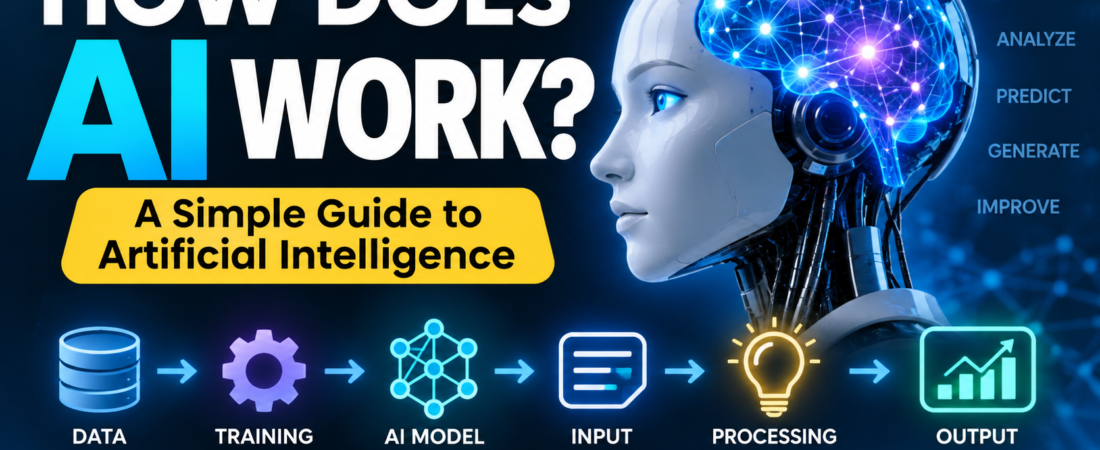
Data → Training → Model → Input → Processing → Output
Imagine you want to create an AI system that can recognize cats in photographs.
First, you provide the system with many examples of images. Some images are labeled as cats and others are labeled as something else.
The AI analyzes these examples and gradually learns patterns that help distinguish cats from other objects.
After training, you give the model a new photograph that it has never seen before.
The model processes the image and produces a prediction such as:
“Cat — 97% probability.”
The AI isn’t necessarily following a huge list of manually written rules such as:
If the animal has two ears, whiskers and four legs, classify it as a cat.
Instead, a machine-learning model can learn useful patterns from examples.
This ability to learn patterns from data is one of the most important ideas behind modern AI.
The Three Main Ingredients Behind AI
Although AI systems can be extremely complicated, three fundamental ingredients are particularly important:
1. Data
AI systems need information to learn from.
Depending on the application, data can include:
- Text
- Images
- Videos
- Audio
- Numbers
- Sensor readings
- Documents
- User interactions
- Database records
The quality and diversity of the data can have a major effect on the resulting model.
Poor-quality or incomplete data can produce poor results.
2. Algorithms and Models
An algorithm is a method for processing information and learning from it.
A trained AI model is the result of applying learning techniques to data.
Different problems require different approaches.
For example, a recommendation system may predict which product a customer is likely to purchase, while a language model predicts patterns in sequences of tokens.
3. Computing Power
Training modern AI models can require enormous amounts of computation.
Specialized processors such as GPUs are frequently used because AI training involves performing huge numbers of mathematical operations.
The combination of large datasets, sophisticated algorithms and powerful computing hardware has helped make modern AI possible at a large scale.
What Is Machine Learning?
Machine learning is one of the most important technologies behind modern AI.
Instead of programming every possible rule manually, developers can train a machine-learning model using data.
For example, suppose you want to predict whether an email is spam.
A traditional program might rely on manually created rules such as:
- If the email contains certain words, increase the spam score.
- If the sender is suspicious, increase the score.
- If there are suspicious links, increase the score.
A machine-learning system can instead learn patterns from large numbers of emails that have already been classified.
Over time, the model adjusts its internal parameters to improve its predictions.
Machine learning can be used for:
- Classification
- Prediction
- Recommendation
- Fraud detection
- Image recognition
- Speech recognition
- Customer analysis
- Search
- Forecasting
How Does Machine Learning Learn?
A simplified machine-learning training process looks like this:
Step 1: Collect Data
Developers collect examples relevant to the task.
For an image-recognition system, this might mean millions of images.
For a language model, the training material can include very large collections of text.
Step 2: Prepare the Data
Raw information often needs to be cleaned, processed or converted into a format the model can use.
Images may be converted into numerical representations.
Text may be broken into smaller units called tokens.
Audio can also be converted into numerical representations.
Step 3: Train the Model
The model receives examples and makes predictions.
The prediction is compared with the desired result or training objective.
The system then adjusts its parameters to reduce the error.
This process can happen millions or billions of times.
Step 4: Evaluate the Model
Developers test the model using data that was not used for training.
This helps determine whether the model has learned useful patterns instead of simply memorizing its training examples.
Step 5: Deploy the Model
Once the model performs sufficiently well for its intended purpose, it can be integrated into an application or service.
When users interact with the application, the trained model performs inference to generate predictions or outputs.
What Is a Neural Network?
A neural network is a machine-learning model made from interconnected computational units.
The idea is loosely inspired by biological neural networks, although artificial neural networks are mathematical systems rather than digital copies of the human brain.
A basic neural network contains layers.
Input Layer
This receives the input information.
For example, an image can be represented as numerical pixel information.
Hidden Layers
The information passes through intermediate layers where mathematical transformations occur.
In deeper networks, there can be many layers.
Different layers can learn different types of patterns.
Output Layer
The final layer produces the model’s output.
For example:
Input: Photograph
Output: Dog
Or:
Input: Customer information
Output: Probability of purchasing a product
During training, the model adjusts its parameters so that its outputs become more useful for the task.
What Is Deep Learning?
Deep learning is a type of machine learning that uses neural networks with multiple layers.
The word deep refers to the depth of the network.
Deep-learning systems have become particularly useful for complicated tasks involving huge amounts of data.
They are widely used in areas such as:
- Computer vision
- Speech recognition
- Natural language processing
- Image generation
- Video analysis
- Recommendation systems
- Scientific research
Modern generative AI systems rely heavily on deep-learning techniques.
How Does AI Learn Patterns?
This is one of the most interesting parts of AI.
Suppose an AI system is trained to recognize handwritten numbers.
At first, its predictions may be very inaccurate.
During training, it compares its predictions against the expected answers.
The difference between the prediction and the desired result produces an error signal.
An optimization process then adjusts the model’s parameters.
This happens repeatedly.
Eventually, the model may discover mathematical patterns that allow it to recognize different shapes.
Importantly, the model doesn’t necessarily learn a human-readable rule such as:
“A 7 always has this exact shape.”
Instead, millions or billions of numerical parameters can collectively represent useful patterns.
What Are AI Parameters?
Parameters are numerical values inside a machine-learning model that are adjusted during training.
They can be thought of as millions or billions of tiny adjustable settings.
During training, these values are modified so that the model becomes better at its task.
Large modern AI models can contain enormous numbers of parameters.
However, having more parameters does not automatically guarantee a better model. Architecture, training data, optimization, evaluation and other factors also matter.
What Is Training in AI?
Training is the process through which an AI model learns useful patterns from data.
Consider a simple example.
Suppose a model is learning to predict the next word in a sentence:
“The sky is ___.”
The model might initially assign probabilities to many possible words.
During training, it learns from enormous numbers of examples and adjusts its parameters.
Eventually, words such as “blue” may receive a high probability in an appropriate context.
This basic idea can be scaled dramatically.
Modern language models can process huge amounts of training material and learn complex statistical relationships between tokens.
What Is Inference?
Training and inference are two different stages.
Training
The model learns or adjusts its parameters.
Inference
The trained model receives new input and produces an output.
For example:
Training:
The model learns from large amounts of data.
Inference:
You ask the model:
“Explain how AI works.”
The model processes your input and generates an answer based on its learned representations and the computation performed at inference time.
This distinction is important because a model does not normally retrain itself from scratch every time someone asks a question.
How Does Generative AI Work?
Generative AI is a category of AI that creates new content.
It can generate:
- Text
- Images
- Audio
- Video
- Music
- Computer code
Instead of simply classifying information, generative models produce new outputs based on an input prompt or other conditions.
For example:
Prompt:
“Write a short story about a robot exploring Mars.”
Output:
The AI generates a new piece of text.
Similarly:
Prompt:
“Create an illustration of a futuristic city.”
An image-generation model can produce an image matching the requested description.
Generative AI is powered by different model architectures depending on the type of content being generated.
How Do AI Chatbots Generate Answers?
Modern AI chatbots often use large language models, or LLMs.
An LLM processes text by representing it as numerical information.
The text is divided into smaller units called tokens.
For example, a sentence may be split into several tokens representing words, parts of words or punctuation.
The model processes these tokens and analyzes their relationships and context.
It then generates an output token by token.
A simplified example is:
Input:
The capital of France is
The model assigns probabilities to possible next tokens.
A token corresponding to Paris may receive a high probability.
The model selects an appropriate next token and continues generating the response.
This process happens repeatedly until the answer is complete.
The actual architecture and decoding process used by modern language models is considerably more sophisticated than this simplified example.
What Are Transformers?
One of the most important developments in modern AI is the transformer architecture.
Transformers are neural-network architectures designed to process relationships within sequences.
They became particularly important for natural-language processing because they can analyze relationships between different parts of an input.
A key concept is attention.
Attention allows a model to determine which parts of the input are particularly relevant when processing another part.
For example, consider:
“John gave Mark his laptop because he needed it for work.”
Understanding who “he” refers to requires considering relationships between different words in the sentence.
Attention mechanisms help transformer models process these relationships.
Transformers now form the foundation of many modern language and multimodal AI systems.
How Does AI Understand Images?
AI can process images by converting visual information into numerical representations.
A photograph contains pixels, and those pixels contain numerical information.
A computer doesn’t see a photograph in exactly the same way a human does.
Instead, a vision model processes numerical representations and learns patterns associated with objects, shapes, textures, colors and other visual characteristics.
During training, the model may see huge numbers of images.
Eventually, it can learn representations useful for tasks such as:
- Object detection
- Image classification
- Face recognition
- Image captioning
- Medical-image analysis
- Visual question answering
Modern multimodal models can combine visual and textual information, allowing users to ask questions about images.
How Does AI Generate Images?
Many modern image-generation systems use generative models that learn statistical patterns from images.
One important approach is the diffusion model.
A simplified explanation is:
- The model learns visual patterns from training data.
- During the generation process, a noisy representation is progressively transformed.
- The model predicts how to remove or reduce the noise.
- Repeated steps produce a final image.
- Text or other conditioning information guides the generated result.
This is a simplified explanation because real image-generation systems can involve sophisticated architectures, conditioning mechanisms and sampling techniques.
The result can be an image that matches a user’s description without being a simple copy of one specific training image.
How Does AI Recognize Speech?
Speech-recognition AI converts spoken audio into information that a computer can process.
A simplified pipeline looks like:
Voice → Audio Signal → Feature Representation → AI Model → Text
For example, when someone says:
“What is artificial intelligence?”
A speech-recognition system processes the audio and predicts the corresponding words.
A language model or another AI system can then process those words and generate a response.
Speech AI is used in:
- Voice assistants
- Automatic captions
- Transcription services
- Call-center systems
- Accessibility tools
- Translation applications
How Does AI Make Recommendations?
Recommendation systems are another common form of AI.
Think about a streaming platform recommending a movie.
The system can consider information such as:
- What you watched
- How long you watched
- What you searched for
- Which items you interacted with
- What similar users enjoyed
- Characteristics of available content
A recommendation model can use these signals to estimate which content you might be interested in.
The system then ranks or selects recommendations.
This is why two people can receive completely different recommendations from the same platform.
Does AI Actually Think Like a Human?
This is an important question.
AI can perform tasks associated with human intelligence, but that does not mean it works exactly like the human brain.
An AI model is a mathematical system trained to identify patterns and produce outputs.
For example, a language model can generate a sophisticated explanation without having human experiences, emotions or consciousness in the human sense.
Therefore, saying that AI “thinks like a human” can be misleading.
A more precise description is that AI systems can perform certain tasks that appear intelligent because they have learned complex patterns and can apply those patterns to new inputs.
Why Does AI Sometimes Make Mistakes?
AI systems are not automatically correct.
A model can produce incorrect information for several reasons.
1. Imperfect Training Data
Training data can contain errors, inconsistencies or incomplete information.
2. Limited Context
A model may not have enough information to determine the correct answer.
3. Ambiguous Questions
A question can have multiple interpretations.
4. Model Limitations
The architecture and training process place limits on what a model can reliably do.
5. Generated Information
Generative AI can produce plausible-sounding information that isn’t actually correct.
This is why important information should be independently verified, especially for medical, financial, legal or other high-stakes decisions.
What Is an AI Hallucination?
An AI hallucination generally refers to a situation where an AI system generates information that appears plausible but is incorrect, unsupported or fabricated.
For example, a chatbot might invent:
- A nonexistent research paper
- A fake quotation
- An incorrect date
- A nonexistent person
- A made-up source
The response may sound confident even though the information is wrong.
This happens because generative models are designed to generate likely outputs based on learned patterns; they are not automatically guaranteed to behave like a fact-checking database.
Tools such as retrieval systems, search, databases and human review can help reduce these problems.
Does AI Learn From Every Conversation?
This depends on the specific AI service, model and settings.
It is important to distinguish between using a model and training or updating a model.
When you send a prompt to an AI application, the system performs inference using the model and available application context.
Whether conversations are stored, reviewed, used for improving models or retained for other purposes depends on the provider’s policies and settings.
Therefore, users should check the privacy documentation and settings of the particular AI service they are using.
What Is Narrow AI?
Most AI systems available today are designed for specific tasks or relatively defined groups of tasks.
Examples include:
- Image-recognition systems
- Recommendation engines
- Translation systems
- Spam filters
- Fraud-detection models
- Voice-recognition systems
- Generative AI applications
These systems can be extremely capable in their intended areas without possessing general human intelligence.
This is commonly referred to as narrow AI or artificial narrow intelligence (ANI).
What Is AGI?
Artificial General Intelligence (AGI) generally refers to a hypothetical form of AI capable of performing a broad range of intellectual tasks with a level of flexibility comparable to human general intelligence.
AGI is different from the specialized AI systems most people use today.
There is no single universally accepted benchmark that settles whether a system qualifies as AGI, and definitions vary among researchers and organizations.
Therefore, claims that a particular system has achieved AGI should be evaluated according to the specific definition and evidence being used.
Where Is AI Used Today?
AI is already used across many industries.
Healthcare
AI can assist with medical-image analysis, research, administrative processes and data analysis.
Finance
Financial organizations use machine learning for areas such as fraud detection, risk analysis and transaction monitoring.
Education
AI can help with tutoring, language learning, content creation and educational assistance.
Entertainment
Recommendation systems help users discover movies, music, videos and games.
Transportation
AI can support navigation, route planning, driver-assistance technologies and logistics.
Retail
Retailers use AI for recommendations, demand forecasting, search and customer-service applications.
Software Development
AI tools can assist programmers with code generation, debugging, documentation and software-related tasks.
What Are the Advantages of AI?
AI can provide several practical benefits.
Automation
AI can automate repetitive tasks and processes.
Speed
Computers can analyze large quantities of information much faster than humans in many situations.
Pattern Detection
Machine-learning models can discover patterns in large datasets that may be difficult to identify manually.
Personalization
AI can tailor recommendations and experiences to individual users.
Accessibility
Speech recognition, translation and computer-vision technologies can make digital services more accessible.
Content Creation
Generative AI can help create drafts of text, images, audio, video and code.
What Are the Limitations of AI?
AI also has important limitations.
Accuracy
AI outputs can be incorrect.
Bias
Models can reproduce or amplify problematic patterns present in their data or design.
Privacy
AI systems can involve significant amounts of data, creating privacy and data-governance considerations.
Security
AI can introduce new cybersecurity challenges and can also be used as a defensive tool.
Cost
Training and operating large AI systems can require substantial computing resources.
Human Oversight
For important decisions, human review can remain necessary.
AI should generally be viewed as a tool whose reliability depends on the particular system, data, task and deployment environment.
The Simple Answer: How Does AI Work?
If you want the shortest possible explanation, remember these six steps:
1. AI receives data
The data can be text, images, audio, video, numbers or other information.
2. The model processes the data
Algorithms and neural networks transform the information mathematically.
3. Training adjusts parameters
During training, the model changes its parameters to improve its performance according to its learning objective.
4. The model learns patterns
The trained parameters encode patterns and relationships that are useful for the task.
5. A user provides new input
This is called inference.
6. AI produces an output
The output could be a prediction, classification, recommendation, generated text, image, audio or another result.
In simple terms:
AI learns patterns from data and uses those patterns to produce useful outputs from new inputs.
A Real-Life Example of How AI Works
Imagine you upload a photograph of a dog to an AI application.
The process may look like this:
Your photo
↓
Image converted into numerical representations
↓
Neural network processes the information
↓
The model identifies learned visual patterns
↓
The model calculates possible classifications
↓
Output: “Dog”
The same general concept can be used for much more complicated tasks.
For a chatbot, the input could be text instead of an image.
For a recommendation system, the input could be user activity.
For a voice assistant, the input could be audio.
The underlying technologies vary, but the broad concept remains similar: process information using a trained model and generate an appropriate output.
Frequently Asked Questions About How AI Works
Is AI just a computer program?
AI is implemented through software and mathematical models, but modern AI systems can be considerably more complex than traditional rule-based programs. Machine-learning systems learn patterns from data rather than relying only on manually written rules.
Does AI have a brain?
No. AI doesn’t have a biological brain. Artificial neural networks are mathematical and computational systems inspired in part by biological neural networks.
Does AI use the internet?
Not necessarily.
An AI model can operate without directly accessing the internet. Some AI applications connect models to search engines, databases, APIs or other external tools to obtain additional information.
Does AI always learn while I use it?
No. Using an AI system does not necessarily mean its underlying model is being retrained after every interaction.
The behavior depends on the particular application and its architecture.
Why does AI need so much data?
Machine-learning models often need substantial amounts of data to learn useful patterns, although the amount and type of data required varies significantly by task and model.
Can AI replace humans?
AI can automate or assist with many tasks, but whether it can replace a particular human role depends on the job, technology, reliability requirements and economic and organizational factors.
In many cases, AI is used as an assistant rather than a complete replacement.
What is the difference between AI and machine learning?
AI is the broader field. Machine learning is one approach within AI that enables systems to learn patterns from data.
What is the difference between machine learning and deep learning?
Deep learning is a subset of machine learning that uses multi-layer neural networks.
How does ChatGPT work?
ChatGPT uses large language-model technology to process user input and generate responses. Modern language models commonly use transformer-based neural-network architectures. The model processes tokens and uses learned patterns and context to generate output.
Can AI make mistakes?
Yes. AI systems can produce incorrect predictions or generated information. AI output should therefore be evaluated according to the importance of the task.
Final Thoughts
AI may seem complicated, but its central concept is easier to understand than it first appears.
At its foundation, AI combines data, algorithms, mathematical models and computing power.
Machine-learning systems use data to learn patterns. Deep-learning systems use multi-layer neural networks to learn complex representations. Generative AI extends these capabilities to produce new text, images, audio, video and other content.
The technology behind modern AI is highly sophisticated, but the basic idea can be summarized in one sentence:
AI learns useful patterns from data and uses those patterns to produce predictions, decisions or generated content when it receives new information.
As AI continues to develop, understanding how it works becomes increasingly useful—not only for programmers and researchers, but for anyone who uses technology in everyday life.