

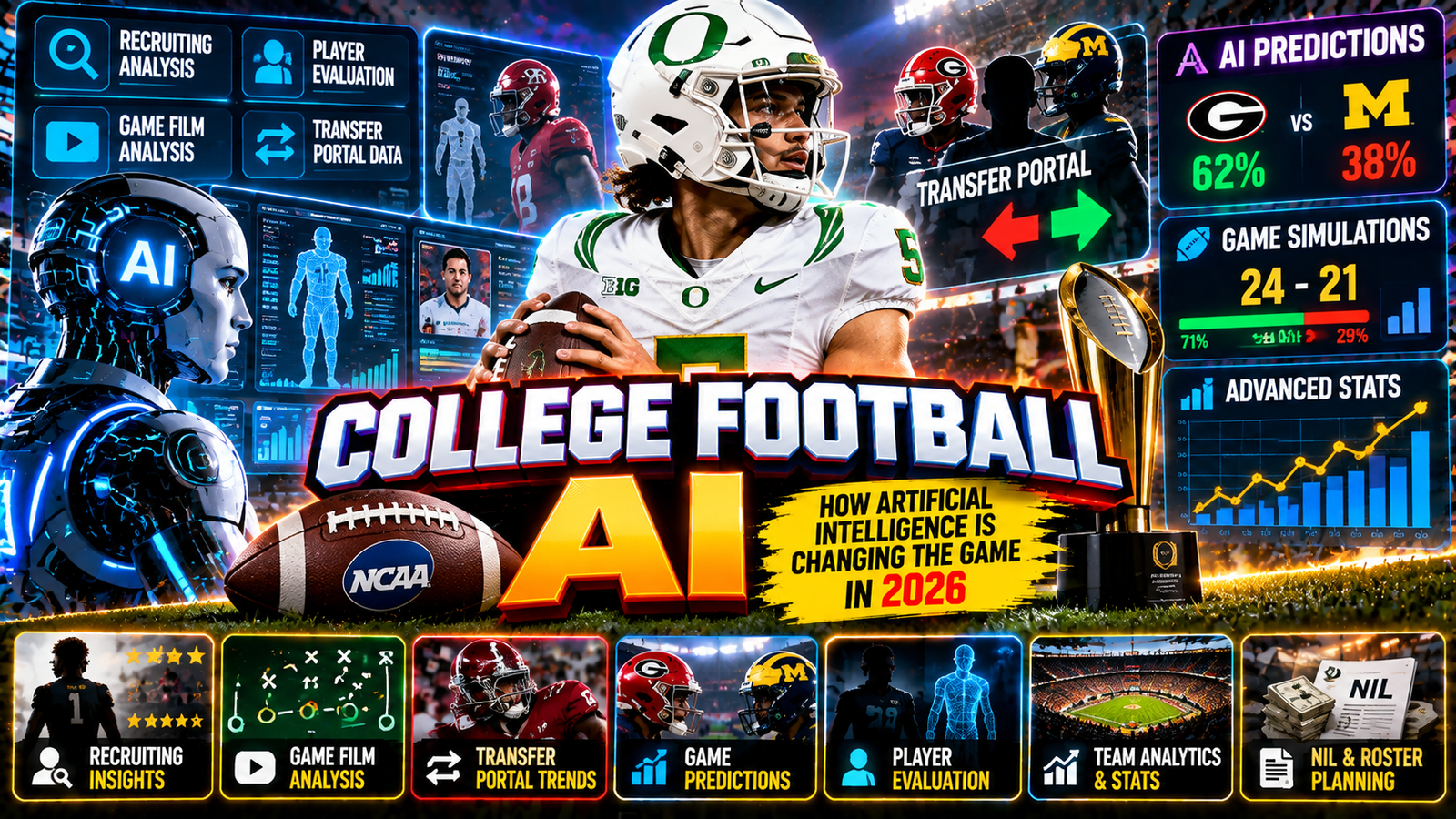
Artificial intelligence is becoming a bigger part of college football every year. For decades, programs relied on coaches, scouts, analysts, and piles of game film to evaluate players and opponents. Today, AI and machine learning can process huge amounts of information much faster, helping teams spot patterns in film, evaluate recruits, study the transfer portal, scout opponents, and build data-driven strategies.
The technology is also reaching fans. AI-powered college football platforms can analyze teams, simulate matchups, visualize transfer activity, and generate statistical insights from thousands of games.
In 2026, AI is no longer just a futuristic idea for college football. It is becoming part of how programs evaluate information and make decisions.
What Is College Football AI?
College Football AI refers to artificial intelligence and machine-learning technology used to analyze, understand, or interact with college football data.
This can include:
- Recruiting analysis
- Player evaluation
- Game-film analysis
- Opponent scouting
- Transfer-portal analysis
- Roster management
- Performance analytics
- Injury and workload monitoring
- Play analysis
- Game simulations
- Fan predictions and statistics
- NIL and roster planning
- Content creation
The key point is that AI does not necessarily replace coaches or scouts. In many cases, it works as an extra analytical tool that processes information and highlights patterns for humans to investigate.
A 2025 CBS Sports report on AI in college football described uses ranging from recruiting to revenue and found that athletic departments were experimenting with AI as a recruiting, scouting, and business tool.
How AI Is Used in College Football
AI can be applied at almost every stage of a college football program.
A modern program may have data coming from:
- Game film
- Player tracking
- Practice sessions
- Recruiting databases
- Transfer-portal information
- Play-by-play statistics
- Strength and conditioning
- Opponent tendencies
- Historical games
- Roster information
AI systems can process these datasets and turn them into reports, visualizations, or recommendations for coaches and analysts.
AI in College Football Recruiting
Recruiting is one of the most obvious areas where AI can help.
College programs evaluate thousands of high-school and transfer players. Traditional recruiting requires coaches and scouts to watch film, attend games, talk to prospects, and compare players manually.
AI can help organize that information.
Player Evaluation
An AI system can potentially analyze things like:
- Passing efficiency
- Throwing accuracy
- Speed
- Acceleration
- Tackling
- Route running
- Defensive positioning
- Explosiveness
- Athletic measurements
- Game performance
Instead of just looking at a player’s total stats, analytical systems can examine the circumstances behind those numbers.
For example, a quarterback’s stats can be analyzed alongside:
- Defensive strength
- Down and distance
- Field position
- Quality of opponents
- Time remaining
- Passing situation
This gives a more detailed picture than a basic box score.
AI and the Transfer Portal
The transfer portal has made roster management much more complicated.
Programs need to track:
- Players entering the portal
- Players leaving programs
- Positions that need help
- Available scholarships
- Player production
- Eligibility
- Team needs
- Potential roster fit
AI and machine-learning systems can help organize this information.
Research published in 2026 has specifically looked at machine-learning and network-analysis approaches to predicting college football transfer destinations. The study describes the transfer portal as a complex network of players and programs and explores how machine learning can model transfer destinations.
This doesn’t mean an AI system knows where a player will transfer. Instead, models can identify statistical relationships and estimate possibilities from historical data.
AI-Powered Transfer Portal Analytics
The growth of specialized analytics platforms shows how important portal data has become.
Some current college-football analytics platforms track:
- Incoming transfers
- Outgoing transfers
- Team roster changes
- Historical player movement
- Talent ratings
- Transfer destinations
- Portal activity
For example, TransferPortl currently describes a system that tracks portal movement and provides model-based transfer analysis, while clearly labeling its forecasts as model estimates rather than insider information.
That distinction matters. An AI model can analyze historical patterns, but it doesn’t have direct access to every private conversation between a player, family, and coaching staff.
AI for College Football Scouting
Scouting involves enormous amounts of video.
A coaching staff may need to review hundreds or thousands of plays before a big game.
AI-powered film-analysis systems can help organize that footage.
For example, an AI system could potentially identify:
- Run plays
- Pass plays
- Blitzes
- Defensive formations
- Receiver routes
- Quarterback movement
- Coverage schemes
- Personnel groupings
- Repeated formations
Instead of manually searching through an entire game, an analyst could use automatically generated tags to find relevant plays.
Some college-football operations platforms now advertise AI-powered film analysis with automatic play detection, tagging, and scout-report generation.
AI for Opponent Analysis
Before a game, coaches need to understand how an opponent normally plays.
AI can analyze previous games to identify tendencies.
For example:
Third Down
An opponent may run a particular formation more often on third-and-short.
Red Zone
A team may favor certain concepts near the goal line.
Passing Situations
A quarterback may show different tendencies depending on down, distance, and defensive pressure.
Defensive Schemes
AI can identify repeated defensive alignments and personnel combinations.
The goal isn’t to let a computer make every coaching decision. Instead, AI can reduce the time analysts spend searching for patterns.
AI Game Simulation
AI and statistical models can also simulate potential game scenarios.
A simulation can use information like:
- Team efficiency
- Offensive production
- Defensive performance
- Turnover rates
- Home-field effects
- Historical results
- Opponent strength
- Player availability
The system can then run thousands of hypothetical scenarios.
For example, Action Network’s 2026 College Football Supercomputer uses a simulation engine covering all 138 FBS teams and says it simulates the rest of the season 20,000 times using historical results, play-by-play efficiency, and preseason ratings.
These simulations are statistical models, not guarantees of what will happen in a real game.
AI College Football Predictions
One of the most popular applications for fans is prediction.
AI-powered platforms can calculate estimated outcomes using statistical models.
For example, a model might compare:
Team A
- Offensive efficiency
- Defensive efficiency
- Recent performance
- Strength of schedule
- Turnover rate
against:
Team B
- Offensive efficiency
- Defensive efficiency
- Recent performance
- Strength of schedule
- Turnover rate
The model can then simulate possible game scenarios.
Some dedicated college-football platforms market AI-powered predictions for FBS games alongside team analytics and game simulations.
However, prediction models should be understood as statistical estimates. College football has unpredictable events like injuries, turnovers, weather, coaching decisions, and unusual game situations.
AI College Football Rankings
AI can also generate statistical rankings.
Instead of ranking teams only by win-loss records, an analytical model can include:
- Opponent strength
- Point differential
- Offensive efficiency
- Defensive efficiency
- Schedule difficulty
- Player performance
- Home and away performance
- Recent results
Different models can produce different rankings because they use different datasets and weighting systems.
So an AI ranking is best understood as one analytical view of the sport, not an objective replacement for every other ranking system.
AI and College Football Players
AI can also be used to analyze individual players.
A quarterback, for example, could be evaluated using:
- Completion percentage
- Expected passing outcomes
- Throw location
- Pressure rate
- Time to throw
- Downfield accuracy
- Third-down performance
- Red-zone performance
Running backs can be analyzed using:
- Rushing efficiency
- Explosive runs
- Yards after contact
- Missed tackles forced
- Route production
- Pass protection
Defensive players can be evaluated using:
- Tackles
- Pressure
- Coverage
- Interceptions
- Pass breakups
- Run-stop efficiency
- Alignment
- Assignment success
The advantage is that AI can combine many different variables rather than relying on one statistic.
AI and College Football Coaches
AI can also help coaches organize information.
A coaching staff could theoretically ask an AI system:
Show every third-down play where the opponent used an empty backfield.
Or:
Find every red-zone possession where the quarterback ran a read-option.
Instead of an analyst manually searching through hours of footage, an AI system could help locate the relevant plays. The coach can then review those clips and make the final football decision.
AI and Recruiting Scouting Reports
AI can also automate parts of the scouting-report process.
A traditional scouting report may contain:
- Player biography
- Position
- Measurements
- Statistics
- Strengths
- Weaknesses
- Film observations
- Competition level
- Athletic testing
- Projection
AI can organize these elements into a standardized report. This can be especially useful for programs evaluating large numbers of recruits.
But AI should not be treated as a perfect evaluator. Recruiting involves factors that are hard to quantify, including personality, development, coaching environment, and individual circumstances.
Sports Illustrated’s 2026 discussion of AI recruiting also emphasized that athletes are not simply datasets and that AI should function as a support system rather than the final authority in recruiting decisions.
AI and NIL
The growth of NIL has added another layer to roster management.
AI can potentially help organizations organize information related to:
- NIL opportunities
- Player marketing
- Social-media performance
- Audience demographics
- Brand campaigns
- Contract information
- Roster budgets
Some college-football operations platforms now advertise NIL budget planning and roster-cost forecasting alongside recruiting and transfer tools.
However, financial and contractual decisions require human oversight and compliance with applicable rules.
AI for College Football Fans
AI isn’t only useful to coaches.
Fans can use AI tools to understand college football in more detail.
For example, an AI football assistant could answer:
How has this team’s offense performed over the last five games?
Or:
Compare the two teams’ passing efficiency.
Or:
Which players have produced the most touchdowns this season?
AI can also turn large statistical datasets into easier-to-understand explanations.
AI College Football Game Simulators
Game simulation is another growing area.
Instead of predicting one result, a simulation can run thousands of hypothetical games.
For example:
- Simulation 1: Team A wins 31–24
- Simulation 2: Team B wins 27–20
- Simulation 3: Team A wins 35–17
- Simulation 4: Team B wins 24–21
The model can repeat this process thousands of times.
The resulting distribution can be used to estimate statistical outcomes.
Again, simulations should not be confused with certainty. They are mathematical scenarios based on the assumptions and data used by the model.
College Football AI Websites
A growing ecosystem of AI and analytics websites now focuses specifically on college football.
Examples include platforms offering:
- AI predictions
- Team analytics
- Game simulations
- Transfer-portal tracking
- Recruiting analysis
- Coaching analytics
- Power ratings
Playmaker’s Edge, for example, currently advertises FBS coverage across 138 teams, AI-based game predictions, team analytics, Monte Carlo game simulations, and transfer-portal visualization.
Other analytics platforms focus more heavily on transfer-portal data and roster movement.
This growing ecosystem gives fans access to analytical tools that were once primarily available to professional sports organizations.
College Football AI and the 2026 Season
AI is becoming especially relevant in the modern college-football environment because programs are dealing with more information than ever.
The sport now involves:
- Expanded conferences
- The transfer portal
- NIL
- Large recruiting databases
- Extensive video
- Player-tracking information
- Advanced statistics
- Complex schedules
- Expanded playoff structures
A coaching staff can only manually process a limited amount of information. AI can help turn that information into something more manageable.
USC and the Rise of Dedicated AI Staff
The growing importance of AI can also be seen in staffing decisions.
In June 2026, reports indicated that USC was preparing to create a dedicated Director of AI position, with analytics director Conor McQuiston reported as the person being moved into the new role.
If adopted more broadly, positions like this would represent a shift from treating AI as an occasional analytics tool to treating it as a dedicated part of a football program’s operations.
AI in College Football 2026: What It Can Do
The current applications can be broadly divided into several categories.
| Area | Possible AI Application |
|---|---|
| Recruiting | Prospect analysis |
| Transfer Portal | Player movement analysis |
| Scouting | Film tagging |
| Game Preparation | Opponent tendencies |
| Analytics | Player and team metrics |
| Simulation | Hypothetical game scenarios |
| NIL | Data organization and forecasting |
| Roster Management | Scholarship and position planning |
| Fan Experience | AI statistics and explanations |
| Media | Content and video generation |
Benefits of AI in College Football
Faster Analysis
AI can process large datasets much faster than manual analysis.
More Information
Coaches and analysts can examine more variables at the same time.
Automated Film Tagging
Large amounts of video can be organized automatically.
Recruiting Efficiency
Programs can sort and compare large numbers of prospects.
Transfer-Portal Analysis
AI can help identify patterns in player movement.
Better Fan Tools
Fans can access advanced statistics and simulations without needing to manually analyze datasets.
Limitations of College Football AI
AI is powerful, but it has limits.
Data Quality
If the underlying data is incomplete or inaccurate, the model’s output can also be inaccurate.
Human Context
Football decisions often involve factors that are hard to quantify.
Injuries
A statistical model may not fully capture the effect of a late injury or sudden lineup change.
Coaching Decisions
A coach can change strategy during a game in ways that historical data cannot perfectly anticipate.
Small Samples
A few games may not provide enough information to accurately evaluate a player or team.
Model Bias
Different models use different assumptions and datasets. This means two AI systems can analyze the same teams and produce different results.
Will AI Replace College Football Coaches?
AI is unlikely to eliminate the need for coaches simply because football is not purely a mathematical problem.
Coaches still have to:
- Develop players
- Manage teams
- Communicate
- Make decisions under pressure
- Understand individual personalities
- Adjust during games
- Build relationships
- Lead a program
AI can process information, but human coaching remains responsible for turning information into action.
The more realistic future is a coach-plus-AI model, where coaches and analysts use AI to process information while humans remain responsible for football decisions.
The Future of College Football AI
The next generation of college-football AI could become much more sophisticated.
Future systems could combine:
Real-Time Game Analysis
AI could analyze a game while it is happening and identify tactical patterns.
Automatic Opponent Reports
A system could generate a complete opponent report after processing multiple games.
Advanced Player Models
AI could build detailed performance profiles for individual athletes.
Transfer-Market Analysis
Models could connect player characteristics with roster needs across hundreds of programs.
Recruiting Intelligence
AI could help identify under-the-radar prospects whose stats and physical profiles suggest development potential.
Interactive Fan Assistants
Fans could ask questions about games, teams, and players and receive answers backed by current statistics.
More Advanced Simulations
Simulation engines could incorporate increasingly detailed player and team data.
College Football AI and the Human Element
The biggest question is not whether AI can analyze football. It clearly can.
The bigger question is how programs use that information.
A computer can identify a statistical pattern, but a coach still needs to determine whether that pattern actually matters.
For example, an AI model may identify that an opponent frequently runs a particular play.
The coaching staff then has to decide:
- Why does the opponent run it?
- Under what circumstances?
- Which players execute it?
- How might the opponent adjust?
- What defensive response makes sense?
That is where human football knowledge remains important.
Final Thoughts
College Football AI is becoming an important part of the modern sport.
From recruiting and transfer-portal analysis to game-film tagging, opponent scouting, player evaluation, and simulations, artificial intelligence can process information at a scale that would be difficult for a human staff to handle manually.
The technology is also becoming accessible to fans through AI-powered college-football analytics platforms, simulations, and statistical tools.
The biggest change may be the shift from AI being a simple statistical tool to becoming part of a broader football workflow.
The future of college football will likely involve a combination of coaches, scouts, analysts, data scientists, and AI systems, with each contributing something different.
AI can find patterns. Data can provide evidence. But football decisions still require context, judgment, and human understanding.
Frequently Asked Questions
What is College Football AI?
College Football AI refers to artificial intelligence and machine-learning systems used for college-football analysis, recruiting, scouting, transfer-portal research, simulations, and fan experiences.
How is AI used in college football?
AI can be used for recruiting, game-film analysis, opponent scouting, player evaluation, roster management, transfer-portal analysis, simulations, and analytics.
Can AI predict college football games?
AI models can generate statistical predictions or simulations, but they cannot guarantee the outcome of an actual game.
Can AI analyze college football film?
Yes. AI-powered football platforms can automatically identify and tag plays in game film, helping analysts find specific situations more quickly.
Can AI help with recruiting?
Yes. AI can organize prospect information, analyze statistics and film, and identify patterns that may help recruiting departments. Human evaluation remains important.
Can AI analyze the transfer portal?
Yes. Current analytics platforms track transfer movement, while research has explored machine-learning approaches to transfer-destination analysis.
Is AI replacing college football coaches?
AI is being developed as an analytical and operational tool. Coaches remain responsible for leadership, player development, and football decisions.
What is the future of AI in college football?
The technology is likely to expand into real-time analysis, advanced player evaluation, automated scouting reports, transfer-market analytics, recruiting intelligence, and interactive fan tools.
Disclaimer: This is an independent, unofficial overview written in original language. It is not affiliated with, endorsed by, or connected to the NCAA, any college football program, or any analytics platform mentioned. All names and trademarks belong to their respective owners. This article is based on publicly available information and is not a substitute for official announcements or verified data.
