

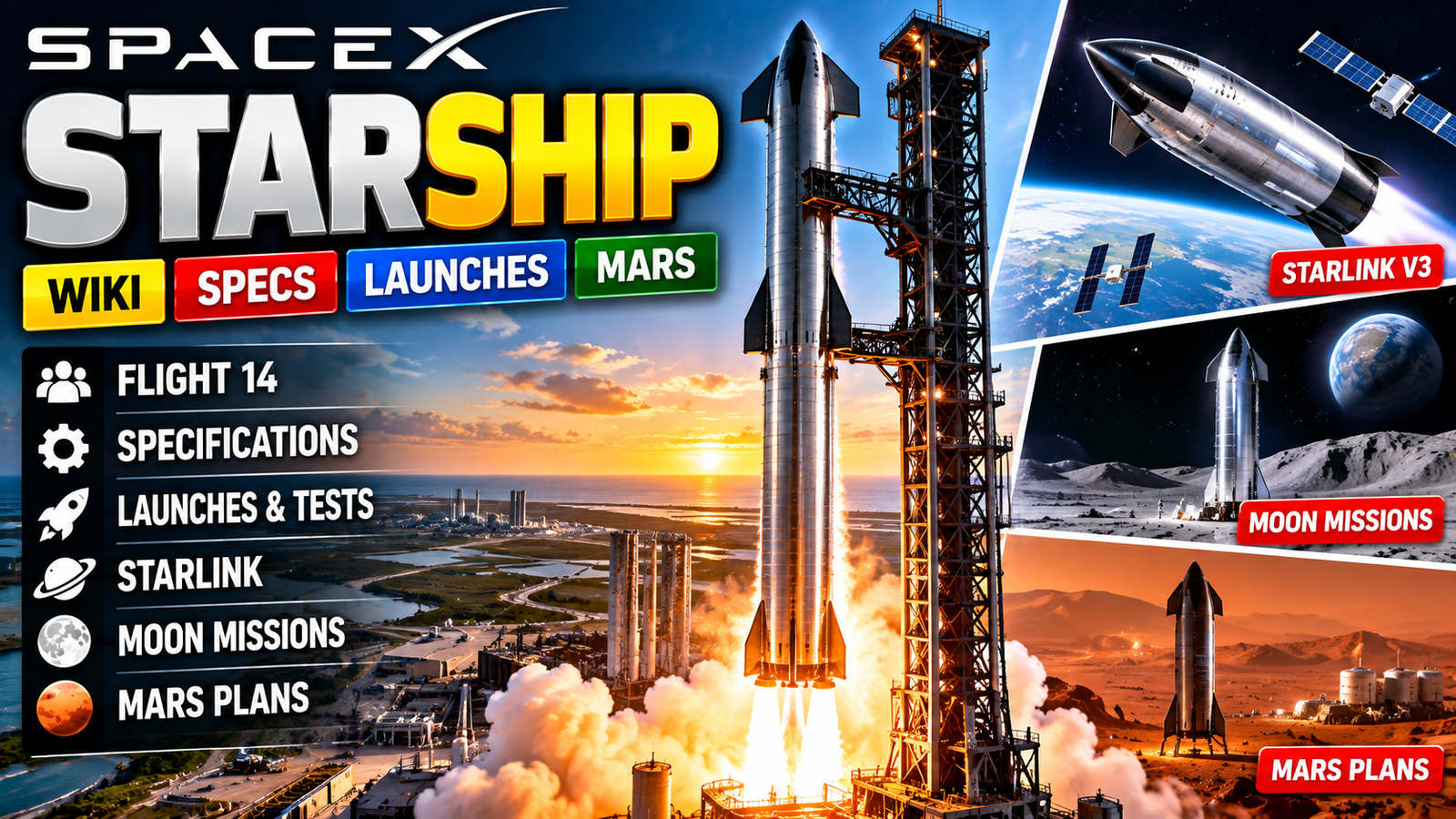
SpaceX Starship is one of the most ambitious launch vehicles ever built. It’s a fully reusable transportation system that pairs the Starship spacecraft with the Super Heavy booster, with the goal of carrying satellites, cargo, and eventually people to Earth orbit, the Moon, and Mars.
As of September 28, 2026, the program has hit another major milestone: Starship Flight 14, which is planned as the vehicle’s first orbital flight. SpaceX has the mission listed for September 28 from Pad 2 at Starbase, Texas, with a launch window from 12:15 to 13:30 UTC (5:45 to 7:00 PM IST).
Current status: Flight 14 is an orbital test mission. Because this article is being prepared around the scheduled launch window, the actual post-launch result should be updated once SpaceX completes the mission.
SpaceX Starship Wiki – Quick Facts
| Information | Details |
|---|---|
| Vehicle | SpaceX Starship |
| Company | SpaceX |
| Type | Fully reusable launch system |
| Stages | Super Heavy + Starship |
| Current Generation | Starship V3 / Super Heavy V3 |
| Fuel | Liquid methane + liquid oxygen |
| Overall Height | 124 m / 407 ft |
| Diameter | 9 m / 29.5 ft |
| Starship Height | 52 m / 171 ft |
| Super Heavy Height | 72 m / 236 ft |
| Reusable Payload Capacity | 100+ metric tons |
| Launch Site | Starbase, Texas |
| Flight 14 | September 28, 2026 |
| Flight 14 Booster | Booster 21 |
| Flight 14 Ship | Ship 41 |
| Flight 14 Payload | 26 Starlink V3 satellites |
| Primary Goal | First orbital Starship test |
SpaceX says the complete Starship system stands 124 meters tall, has a 9-meter diameter, and is designed to carry more than 100 metric tons to orbit in a fully reusable configuration.
What Is SpaceX Starship?
Starship is SpaceX’s next-generation heavy-lift launch system. Unlike a conventional expendable rocket, its long-term design goal is to recover and reuse both major stages.
The system has two primary vehicles:
- Super Heavy – the enormous first-stage booster.
- Starship – the upper-stage spacecraft that continues into space.
Together they are generally referred to as Starship.
The idea is straightforward but technically difficult: launch a very large vehicle, separate the stages, return both vehicles, recover them, and eventually fly them again with minimal refurbishment.
SpaceX describes Starship as a transportation system intended for Earth orbit, the Moon, Mars, and beyond.
Starship and Super Heavy Explained
Super Heavy Booster
Super Heavy is the first stage of the system.
The current Super Heavy design is approximately 72 meters tall and 9 meters wide. SpaceX says it uses 33 Raptor engines, burning liquid methane and liquid oxygen. Its listed thrust is approximately 8,240 metric-ton-force (18.1 million pounds-force).
During a normal future mission, Super Heavy would provide the enormous thrust required to lift the complete Starship stack away from Earth.
After stage separation, the booster is intended to perform a flip and return toward the launch site.
SpaceX’s ultimate recovery concept involves catching the booster using the launch tower’s mechanical arms, commonly nicknamed the “chopsticks.”
Starship Upper Stage
The upper stage is the spacecraft itself.
SpaceX lists Starship at approximately 52 meters tall, with the same 9-meter diameter as Super Heavy. It has a listed propellant capacity of about 1,600 metric tons and a thrust rating of approximately 1,614 metric-ton-force for the vehicle’s engine configuration.
Unlike Super Heavy, Starship is designed to continue the mission after separation.
Depending on the mission, the spacecraft could:
- Deploy satellites
- Carry cargo
- Remain in Earth orbit
- Transfer propellant
- Travel toward the Moon
- Land on the Moon
- Eventually travel toward Mars
The long-term concept also includes crewed versions.
Starship V3: The New Generation
The 2026 flight campaign introduced the V3 generation of Starship and Super Heavy.
SpaceX says the third generation incorporates lessons learned from years of flight testing and includes significant changes to the booster and integrated vehicle.
One important change involves the Super Heavy grid fins. The V3 booster uses three larger grid fins instead of four, with the fins strengthened and repositioned to support future lift and catch operations. SpaceX has also integrated the hot-staging architecture differently from earlier versions.
Another major change is the introduction of Raptor 3.
Raptor is SpaceX’s methane/oxygen staged-combustion engine family. Super Heavy uses 33 engines, while Starship uses six engines: three sea-level Raptors and three vacuum-optimized Raptors.
The first V3 flight was Starship Flight 12 on May 22, 2026. SpaceX says that mission was the first flight of the V3 Starship and Super Heavy vehicles, the first flight using Raptor 3, and the first Starship flight from Pad 2.
Starship Flight 12
Flight 12 was an important development mission because it introduced the V3 architecture.
The Super Heavy booster successfully lifted off with all 33 Raptor 3 engines. One engine shut down during ascent, but the vehicle continued its planned trajectory.
After hot-staging, Starship continued toward space. During the ascent burn, one Raptor vacuum engine was lost, but the spacecraft demonstrated its ability to continue flying after an engine issue.
Starship also deployed experimental Starlink hardware and later performed re-entry and landing demonstrations before splashing down in the Indian Ocean.
The flight therefore provided SpaceX with data covering several important areas:
- Raptor 3 performance
- V3 vehicle performance
- Hot staging
- Payload deployment
- Engine-out capability
- Heat-shield performance
- Atmospheric re-entry
- Flap-controlled descent
- Landing-burn behavior
Starship Flight 13
The next V3 mission, Flight 13, launched on July 24, 2026.
SpaceX says Flight 13 successfully completed first-stage ascent and hot staging. Super Heavy then attempted its boostback and landing sequence, eventually experiencing a hard splashdown in the Gulf.
The Starship upper stage completed its full-duration ascent burn, deployed 20 Starlink V3 satellites, demonstrated an in-space Raptor relight, and performed its controlled atmospheric re-entry. It ultimately achieved a soft splashdown in the Indian Ocean.
The mission was particularly significant because it successfully demonstrated deployment and communications with the next-generation Starlink V3 satellites.
Starship Flight 14: The First Orbital Starship Mission
Flight 14 represents a major change from the previous Starship tests.
SpaceX has intentionally flown earlier Starship missions on suborbital trajectories. Flight 14 is planned to be the first mission to send the Starship upper stage into an actual orbit around Earth.
The mission uses:
- Booster: B21
- Ship: S41
- Launch site: Starbase Pad 2
- Target date: September 28, 2026
- Launch window: 12:15–13:30 UTC
- Payload: 26 Starlink V3 satellites
SpaceX’s launch listing confirms the September 28 window.
What Will Flight 14 Do?
The mission is designed around several major objectives.
1. Reach Earth Orbit
The biggest milestone is orbital insertion.
Previous Starship missions were deliberately placed on trajectories that brought the spacecraft back to Earth without completing an orbit.
For Flight 14, SpaceX plans to perform the maneuver necessary to enter Earth orbit. The planned orbit is approximately 275 kilometers above Earth.
2. Deploy Starlink V3 Satellites
Flight 14 is scheduled to deploy 26 Starlink V3 satellites.
This makes Starship more than just a technology demonstrator: the mission is also intended to demonstrate the system’s ability to perform an actual orbital payload-delivery operation.
3. Complete Multiple Orbits
The planned mission profile calls for Starship to complete approximately six orbits before beginning its return sequence.
That is dramatically different from previous suborbital flights.
4. Test Re-Entry
After spending several hours in orbit, Starship will perform a de-orbit maneuver and begin atmospheric re-entry.
The spacecraft’s heat shield and aerodynamic control system will be tested under the more demanding conditions associated with an orbital mission.
5. Pacific Splashdown
For Flight 14, the Starship upper stage is planned to splash down in the Pacific Ocean west of Chile, rather than returning to Starbase.
Super Heavy is planned to splash down separately in the Gulf.
Why Flight 14 Matters

An orbital Starship flight is important because many of the system’s eventual applications require the spacecraft to operate in orbit rather than simply perform a short suborbital flight.
Orbit introduces additional challenges involving:
- Orbital velocity
- Thermal protection
- Long-duration operation
- Payload deployment
- Attitude control
- Propellant management
- In-space engine relights
- De-orbit operations
- Atmospheric re-entry
Successfully demonstrating these capabilities would provide additional flight data for the next stages of Starship development.
However, an orbital test would not mean Starship is immediately ready for routine commercial or human missions. The vehicle still has multiple technologies and operational requirements to demonstrate.
Why Starship Uses Methane
One of Starship’s defining technical choices is its use of liquid methane (CH₄) and liquid oxygen (LOX).
The Raptor engine is designed around a methane-oxygen propellant combination.
Methane is particularly important to SpaceX’s long-term Mars architecture because methane can potentially be produced from resources available on Mars through chemical processes involving atmospheric carbon dioxide and water-derived hydrogen.
That makes methane attractive for a transportation system intended eventually to operate beyond Earth.
Starship’s Heat Shield

Returning from orbit is one of the most demanding parts of the Starship concept.
The spacecraft uses a large thermal-protection system to survive atmospheric re-entry.
Instead of returning like a traditional capsule, Starship is designed to enter the atmosphere in a controlled belly-first configuration.
Its aerodynamic flaps allow the spacecraft to control its orientation during descent.
Near the end of the landing sequence, Starship is intended to transition from its horizontal descent configuration into a vertical position and use its engines for the final landing maneuver. SpaceX has described this approach as a way to reduce propellant requirements while allowing controlled landings at destinations without runways.
The Starship Catch System
One of Starship’s most recognizable technologies is the launch tower’s giant mechanical arms.
These arms are intended to catch returning vehicles instead of requiring a traditional landing pad.
The concept is important because SpaceX wants Starship to be rapidly reusable.
If a vehicle can return to the same launch infrastructure, be caught, inspected and prepared for another flight quickly, the system could potentially support a much higher launch cadence.
SpaceX says Starship and Super Heavy are designed for full and rapid reuse, including returning to the launch site and being caught by the tower.
Super Heavy has already demonstrated tower catches during earlier testing, but Starship itself has not yet completed a tower catch. Flight 14 is not planned to attempt a Ship catch.
Starship and Starlink
Starlink is one of the most important practical uses for Starship.
SpaceX is developing Starship partly to provide dramatically greater payload capacity than its existing Falcon rockets.
The larger vehicle could eventually deploy large numbers of satellites in a single mission.
The 2026 V3 Starship flights have already begun integrating Starlink technology into the flight-test program. Flight 13 deployed 20 Starlink V3 satellites, while Flight 14 is planned to deploy 26.
This creates a direct connection between two major SpaceX projects:
- Starship → lower-cost/high-volume space transportation
- Starlink → large-scale satellite communications network
Starship and the Moon
Starship is also being developed as a lunar transportation system.
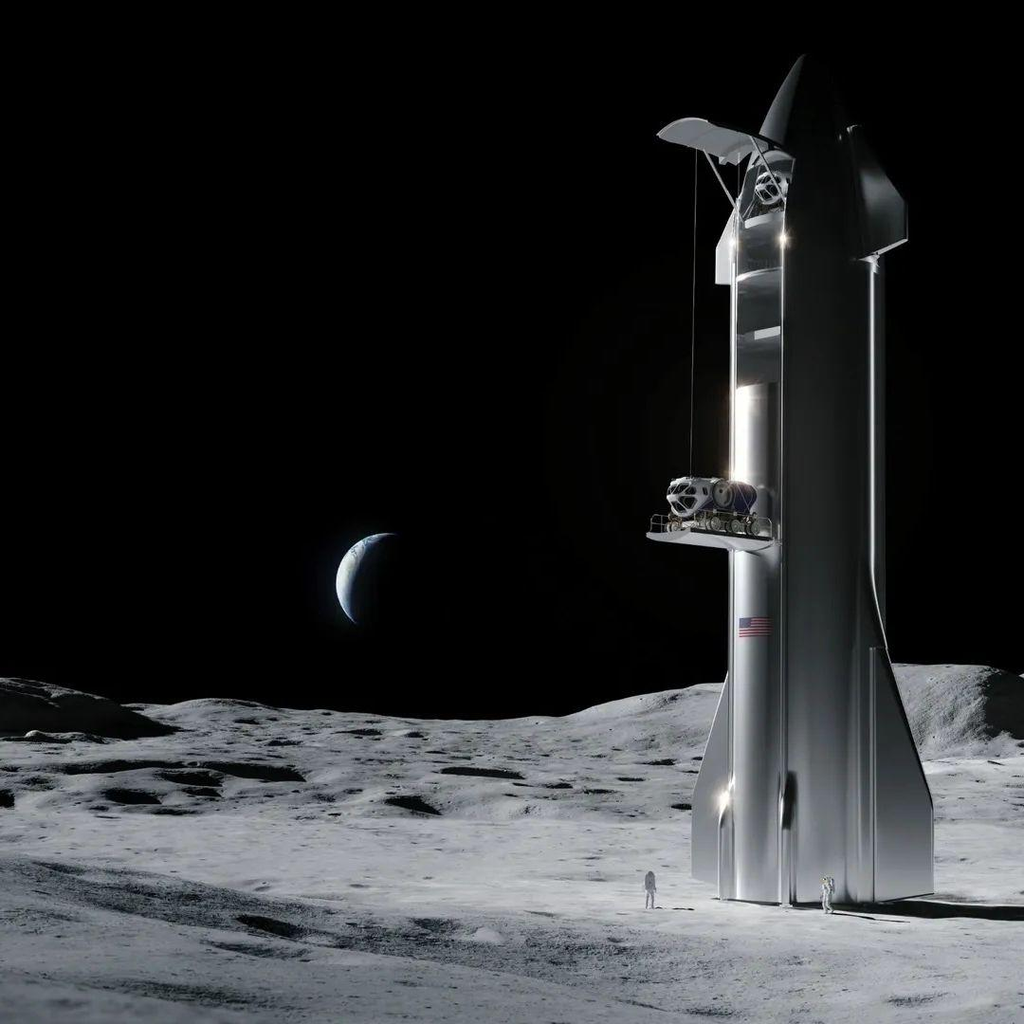
NASA is working with SpaceX on a specialized version called the Starship Human Landing System (HLS).
Unlike the standard Earth-to-orbit Starship, the lunar lander configuration is designed specifically for missions between lunar orbit and the Moon’s surface.
NASA says SpaceX’s Starship HLS is being developed for Artemis missions and will transport astronauts from lunar orbit to the lunar surface and back.
The lunar version is expected to require significant modifications compared with the normal Starship spacecraft.
Why Starship Needs Orbital Refueling
One of the most important technologies for future Moon and Mars missions is in-space propellant transfer.
A Starship leaving Earth with enough propellant to perform every part of a long-distance mission would face major mass limitations.
SpaceX’s architecture therefore envisions tanker Starships transferring propellant to another Starship in Earth orbit.
SpaceX describes this as a key part of enabling Starship to carry much larger amounts of cargo toward destinations such as Mars.
This means Starship’s development is not simply about building a giant rocket. It is about creating an entire transportation architecture involving:
- Launch vehicles
- Tanker vehicles
- Orbital propellant storage
- Payload ships
- Lunar landers
- Recovery infrastructure
- High-frequency launches
Starship and NASA Artemis

NASA is developing Starship HLS as one of the lunar landing systems supporting the Artemis campaign.
NASA’s current Artemis IV information lists the mission as a planned 2028 crewed surface-landing mission, with astronauts traveling to lunar orbit and two crew members descending to the lunar surface using a human landing system.
NASA has also been working with SpaceX on testing related to the Starship HLS architecture. In July 2026, NASA reported wind-tunnel testing involving the Super Heavy V3 design to study aerodynamic forces relevant to the system.
For Starship, this makes successful uncrewed development flights especially important because the lunar version ultimately has to meet much more demanding human-spaceflight requirements.
Starship and Mars
Mars remains one of SpaceX’s biggest long-term objectives for Starship.
The basic concept is to use Starship as a large reusable transportation system capable of moving people and cargo between Earth and Mars.
The challenge is considerably greater than reaching Earth orbit.
A Mars transportation architecture would require:
- High launch cadence
- Orbital refueling
- Long-duration spacecraft operation
- Large cargo capacity
- Reliable atmospheric entry
- Mars landing
- Surface power and life-support infrastructure
- Eventually, a method of producing return propellant
SpaceX’s current Starship information lists Mars cargo missions as no earlier than 2028, although such long-term dates remain dependent on development progress and mission readiness.
Starship Specifications
| Specification | Starship System |
|---|---|
| Overall height | 124 m |
| Overall diameter | 9 m |
| Starship height | 52 m |
| Super Heavy height | 72 m |
| Reusable payload capacity | 100+ metric tons |
| Super Heavy engines | 33 Raptor |
| Starship engines | 6 |
| Main propellants | Methane + liquid oxygen |
| Starship propellant capacity | ~1,600 metric tons |
| Super Heavy propellant capacity | ~3,650 metric tons |
| Launch location | Starbase, Texas |
| Primary purpose | Earth orbit, Moon, Mars and beyond |
These are SpaceX’s published system specifications; actual flight performance can vary depending on mission profile, vehicle version and recovery requirements.
Is Starship Fully Reusable Yet?
Not in routine operational service.
Full and rapid reusability is the intended end state, but Starship remains a development and flight-test program.
The program has already demonstrated important pieces of the concept, including controlled booster recovery and multiple controlled Starship atmospheric-return tests. SpaceX continues to work toward recovering and rapidly reusing both stages.
The distinction is important: designed for full reusability does not mean the complete system has already achieved airline-style routine reuse.
Starship vs Falcon 9
Starship is not simply a larger Falcon 9.
| Feature | Starship | Falcon 9 |
|---|---|---|
| Architecture | Two-stage system | Two-stage rocket |
| Propellant | Methane + LOX | RP-1 + LOX |
| First stage | Super Heavy | Falcon 9 booster |
| Upper stage | Starship spacecraft | Falcon 9 second stage |
| Reusability goal | Both stages | First stage routinely reused |
| Approx. height | 124 m | ~70 m |
| Diameter | 9 m | 3.7 m |
| Primary future role | Heavy cargo, crew, Moon, Mars | Satellites, crew, cargo |
The scale difference is substantial. SpaceX describes Starship as a system designed for more than 100 metric tons to orbit in a fully reusable configuration.
Future of SpaceX Starship
The future Starship roadmap depends on successful development of several capabilities.
Among the most important are:
Orbital payload delivery
Starship must demonstrate reliable delivery of useful payloads into orbit.
Rapid reuse
Both stages need to become reusable with much shorter turnaround times.
Ship recovery
SpaceX eventually wants to catch the upper stage at the launch tower.
Orbital propellant transfer
This is essential for ambitious lunar and Mars missions.
Lunar Starship
The HLS version must be developed and tested for NASA’s Artemis program.
Higher launch cadence
The entire system needs supporting infrastructure capable of handling frequent launches.
SpaceX has also described future generations of Starship with substantially greater payload capability. Its 2026 corporate materials describe V3 as designed around roughly 100 metric tons to orbit in a reusable configuration, while future generations could increase that capacity further.
Frequently Asked Questions
What is SpaceX Starship?
SpaceX Starship is a reusable launch system consisting of the Starship spacecraft and Super Heavy booster. It is designed for transporting cargo and crew to Earth orbit and eventually the Moon and Mars.
How tall is Starship?
The complete Starship/Super Heavy system is approximately 124 meters (407 feet) tall.
How powerful is Starship?
SpaceX lists Super Heavy at approximately 8,240 metric-ton-force of thrust, using 33 Raptor engines.
What fuel does Starship use?
Starship uses liquid methane and liquid oxygen.
What is Starship Flight 14?
Flight 14 is the planned first orbital Starship test mission, scheduled for September 28, 2026, from Starbase. It is planned to deploy 26 Starlink V3 satellites.
Will Starship land on Flight 14?
Flight 14 is not planned to perform a tower catch of the Starship upper stage. The planned profile calls for Starship to splash down in the Pacific Ocean after its orbital mission.
Can Starship go to Mars?
That is one of the system’s long-term goals. SpaceX envisions Starship transporting cargo and eventually people to Mars, with orbital refueling playing a major role.
Is Starship being developed for NASA?
Yes. NASA is working with SpaceX on a Starship Human Landing System for the Artemis lunar program.
How many people can Starship carry?
SpaceX says the Starship system is intended to eventually carry up to 100 people on long-duration interplanetary flights.
Final Thoughts
SpaceX Starship has evolved from an experimental launch vehicle into a broader transportation architecture involving orbital payload delivery, Starlink deployment, lunar exploration, and eventually Mars missions.
The most important immediate milestone is Flight 14, scheduled for September 28, 2026. Its planned orbital profile, Starlink V3 deployment, and extended mission duration represent a significant step beyond the earlier suborbital flight tests.
At the same time, Starship should still be viewed as a vehicle under development. Reaching orbit is only one part of the larger challenge. Rapid reuse, Starship recovery, orbital refueling, lunar operations, and human-rating all remain critical pieces of the eventual architecture.
If those technologies mature successfully, Starship could become much more than a very large rocket: it could become the transportation infrastructure SpaceX is building around its long-term Earth-orbit, Moon, and Mars ambitions.
