

There are video games that stay popular for a few years, and then there are games that keep shaping the industry decades after they first came out.
The Legend of Zelda: Ocarina of Time firmly belongs in that second group.
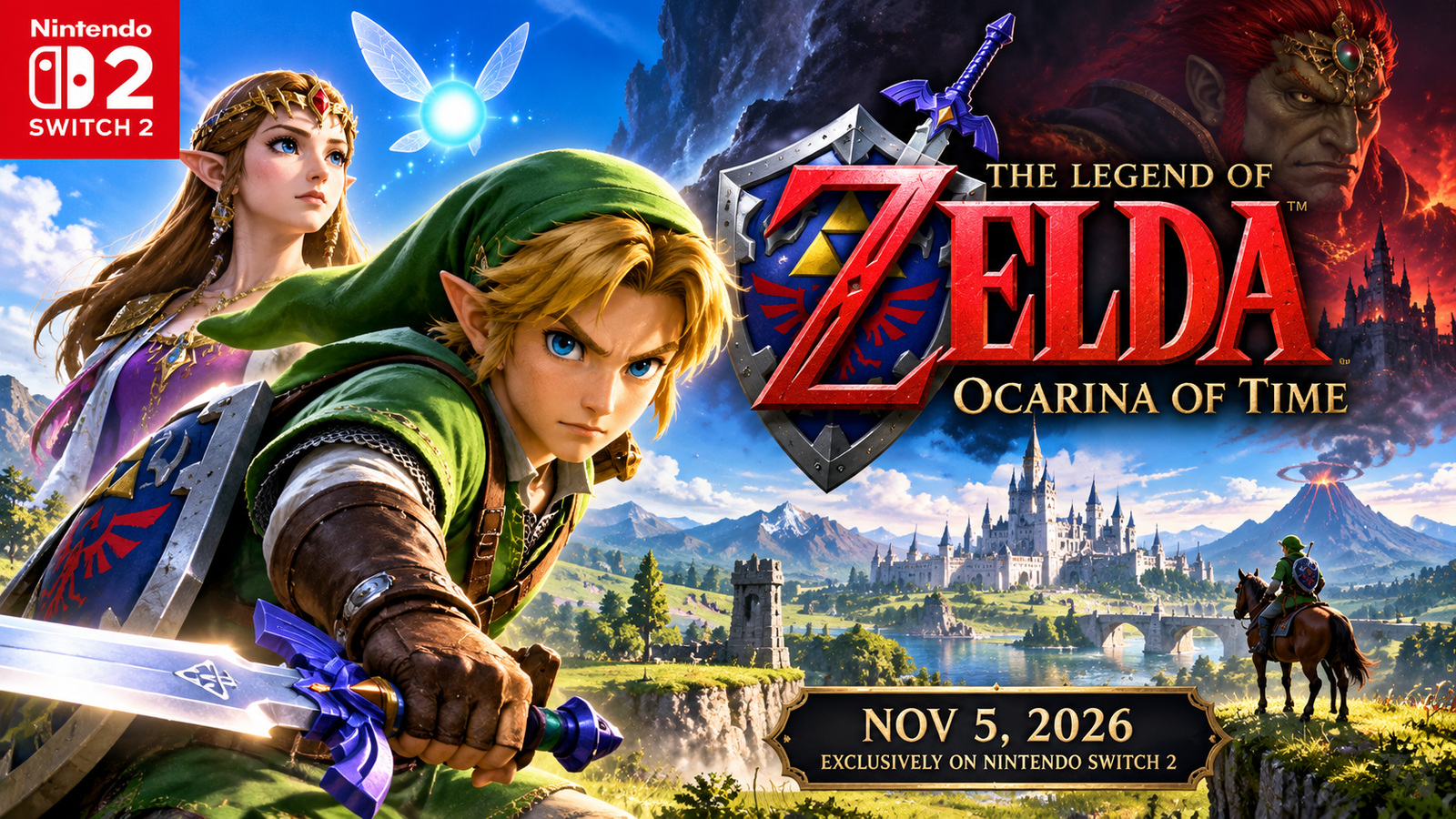
Originally released back in 1998, Nintendo’s legendary adventure is making a return in a completely rebuilt form for Nintendo Switch 2 on November 5, 2026. Instead of just dropping the original game onto a modern console, Nintendo is rebuilding the whole experience with redesigned visuals, expanded dialogue, voiced cutscenes, refreshed music, and modernized movement and camera controls.
That makes this upcoming release especially interesting for two very different groups of players: longtime Zelda fans who remember the original adventure and newcomers who have never experienced Link’s journey through time.
A Classic Zelda Adventure, Rebuilt for a New Generation
At the heart of Ocarina of Time is a young Link who lives in the Kokiri Forest.
Unlike the other children around him, Link doesn’t have a fairy companion. His life changes when the Great Deku Tree sends the fairy Navi to guide him.
What starts as a relatively small adventure quickly turns into something much bigger.
Link eventually leaves the forest and enters Hyrule, where he becomes involved in a conflict surrounding the Triforce, Princess Zelda, and the ambitions of Ganondorf.
Nintendo describes the new version as being built from the ground up for Nintendo Switch 2, preserving the classic story while significantly changing how the game looks and plays.
The Story Still Revolves Around Time
One of the most important ideas in Ocarina of Time is time itself.
Link’s adventure doesn’t simply move from one location to another. His journey spans two different eras, allowing players to experience Hyrule as both a child and an adult.
The Ocarina is at the heart of this mechanic.
Different songs can affect the world around Link, opening paths, changing conditions, and helping him interact with the mysterious forces surrounding Hyrule.
The new Nintendo Switch 2 version retains this central concept while adding new presentation and control features.
What Is New in the Nintendo Switch 2 Version?
This isn’t being presented as a simple HD port.
Nintendo has rebuilt significant portions of the experience for modern hardware.
Completely Overhauled Visuals
The environments, characters, and objects have received new visual treatment.
Textures have been rebuilt, locations have been remodeled, and the overall presentation has been brought much closer to what modern players expect from a major adventure game.
The result is still recognizably Ocarina of Time, but it is designed to feel like a modern release rather than a Nintendo 64-era game.
Voiced Cutscenes and Expanded Dialogue
Another major change is the addition of fully voiced cutscenes and expanded character dialogue.
This gives characters more opportunities to communicate during important parts of the story instead of relying exclusively on the text-heavy presentation of the original game.
Improved Movement
Nintendo is also introducing modernized movement.
Link can now jump and dash using newly added button commands, making movement feel more immediate than the original game’s control system.
Modern Camera Controls
Camera movement has also been redesigned.
The new version allows players to use the Right Stick for improved camera control, giving the adventure a more contemporary feel.
A New Soundtrack
The original game’s memorable music has been refreshed with symphonic orchestral music.
That could make some of the game’s most recognizable locations and story moments feel dramatically different, even though the underlying adventure remains familiar.
Exploring Hyrule Again
One of the biggest reasons Ocarina of Time has remained important is the way it turns Hyrule into an adventure space rather than simply a series of levels.
Players travel between different environments, meet characters, discover secrets, and gradually gain access to new areas.
The world includes locations such as:
- Kokiri Forest
- Hyrule Castle
- Kakariko Village
- Death Mountain
- Zora’s Domain
- Lake Hylia
- Gerudo territory
- The Lost Woods
- The Sacred Realm
Each area contributes something different to Link’s journey.
Some are important for the story, while others hide collectibles, optional activities, or characters that make Hyrule feel like a living world.
The Switch 2 version also gives players more freedom with the camera in remodeled environments. Nintendo says the day-and-night cycle now continues even while Link is inside towns, adding another small layer of immersion to the world.
The Ocarina Is More Than Just an Instrument
The title of the game comes from one of its most important objects: the Ocarina of Time.
The instrument is not simply a collectible.
It becomes one of Link’s primary tools.
Songs can perform different functions throughout the adventure, from opening paths and changing time to interacting with characters and the environment.
Nintendo’s new version also introduces an interesting modern feature: players can use the microphone on a compatible Nintendo Switch 2 system to hum melodies, with Link responding by playing the corresponding tune.
That is a surprisingly fitting addition for a game whose identity is so closely connected to music.
Ganondorf’s Plan
The central conflict begins with Ganondorf’s attempt to obtain the Triforce.
The legendary object is divided into three aspects associated with power, wisdom, and courage, and its existence becomes the source of a major struggle within Hyrule.
Link’s journey therefore becomes much more than an ordinary quest.
He has to uncover what happened to Hyrule, understand the significance of the Triforce, and eventually confront the threat facing the kingdom.
The story’s time-travel structure is one of the elements that makes the game particularly memorable.
Dungeons Are Still a Major Part of the Adventure
Unlike the enormous open-world structure of Breath of the Wild and Tears of the Kingdom, Ocarina of Time follows a much more structured adventure design.
Dungeons are a major part of the experience.
Players enter large areas filled with:
- Puzzles
- Locked doors
- Hidden rooms
- Enemies
- Switches
- Traps
- Mini-bosses
- Boss battles
- Special items
The classic Zelda formula is built around discovering a new item and then figuring out how that item can be used to progress further.
That design philosophy is one of the reasons the game remains so influential.
Combat and Exploration
Link’s primary weapon is his sword, but his equipment expands throughout the adventure.
Depending on the situation, players can use different weapons and tools to solve problems or defeat enemies.
The experience isn’t purely about fighting.
A large part of the game involves looking at the environment and asking:
What can I do with the tools I have?
That philosophy is still visible in later Zelda games, although modern entries have expanded it dramatically.
How Ocarina of Time Connects to Modern Zelda
Nintendo’s Zelda timeline gives Ocarina of Time a particularly important position.
According to Nintendo’s official Zelda history, the events of Ocarina of Time lead to different timeline paths. The story branches into different eras following Link’s journey.
This makes the game more than just another Zelda adventure.
It is one of the key stories used to understand the broader mythology of the franchise.
At the same time, newcomers do not need to understand the entire Zelda timeline before playing.
The game is designed to work as its own adventure.
How It Compares With Breath of the Wild and Tears of the Kingdom
Modern Zelda fans may notice just how different Ocarina of Time is from Nintendo’s recent open-world games.
Ocarina of Time
The adventure is more structured.
Players generally follow a progression through story locations and dungeons, with new items unlocking new possibilities.
Breath of the Wild
Nintendo moved the series toward a massive open world where players could approach many objectives in different ways.
Tears of the Kingdom
The formula expanded even further with exploration across the surface, sky, and underground Depths of Hyrule.
Echoes of Wisdom
Nintendo also experimented with a completely different approach in Echoes of Wisdom, allowing Princess Zelda herself to become the main playable character.
Instead of relying primarily on a traditional sword-based adventure, Zelda uses the Tri Rod to create “echoes” of objects and creatures.
This makes the Zelda franchise particularly interesting: Nintendo continues to reuse familiar characters and mythology while changing the actual gameplay formula from one generation to another.
The Legend of Zelda: Ocarina of Time Release Date
The rebuilt version of The Legend of Zelda: Ocarina of Time launches on:
November 5, 2026
The game is being released exclusively for Nintendo Switch 2.
Nintendo lists the game as a single-player adventure supporting handheld, tabletop, and TV modes.
The estimated game file size is approximately 27 GB.
Zelda Notes Adds a Companion Experience
Nintendo is also introducing ZELDA NOTES, a game-specific service available through the Nintendo Switch App.
The service can provide additional assistance during the adventure, including information about accomplishments and challenges involving locations.
There is even an option to interact with an ocarina through a compatible smart device.
It is an interesting example of Nintendo adding a modern companion feature to a game originally designed decades ago.
Nintendo Switch 2 Features
The new version supports several Nintendo Switch 2 features, including:
- Handheld mode
- TV mode
- Tabletop mode
- HDR output on compatible TVs
- VRR output on compatible TVs
- Surround sound
- Save Data Cloud
- Zelda-series amiibo support
Nintendo also says that existing Zelda-series amiibo can provide in-game extras.
New Young Link and Young Zelda amiibo are planned for 2027 and are set to provide masks inspired by a retro graphical style.
Why This Game Still Matters
The interesting thing about Ocarina of Time isn’t simply that it is an old Zelda game returning on new hardware.
Its influence can still be seen in modern action-adventure games.
The combination of:
- Third-person exploration
- Lock-on combat
- Puzzle-focused dungeons
- Item-based progression
- Environmental interaction
- Character-driven storytelling
- Large fantasy environments
- Time-based mechanics
helped establish a template that countless games would later build upon.
The 2026 version gives Nintendo an opportunity to introduce that experience to players who may have grown up with Breath of the Wild or Tears of the Kingdom rather than the Nintendo 64 original.
Final Thoughts
The Legend of Zelda: Ocarina of Time is returning at a fascinating moment for the franchise.
Nintendo isn’t simply preserving the original adventure exactly as it appeared in 1998. The Nintendo Switch 2 version introduces redesigned visuals, expanded dialogue, voiced cutscenes, orchestral music, modern camera controls, new movement options, and additional features designed around current hardware.
At its heart, though, it remains the same legendary adventure: a young Link, a mysterious fairy, the kingdom of Hyrule, Princess Zelda, Ganondorf, the Triforce, and an Ocarina capable of connecting different eras.
For longtime Zelda players, it is a return to one of the franchise’s most important adventures.
For newcomers, it could become an entirely new way to experience one of Nintendo’s most famous worlds.
The Legend of Zelda: Ocarina of Time – Key Details
| Detail | Information |
|---|---|
| Game | The Legend of Zelda: Ocarina of Time |
| Developer | Nintendo |
| Publisher | Nintendo |
| Genre | Action-adventure |
| Platform | Nintendo Switch 2 |
| Release Date | November 5, 2026 |
| Players | 1 |
| Main Character | Link |
| Princess | Zelda |
| Main Antagonist | Ganondorf |
| Core Artifact | Triforce |
| Major Gameplay Feature | Time travel |
| Major Item | Ocarina of Time |
| Estimated Size | 27 GB |
| Modes | TV, Tabletop, Handheld |
| Music | Refreshed/symphonic presentation |
| Controls | Modernized movement and camera |
| System | Nintendo Switch 2 |
