
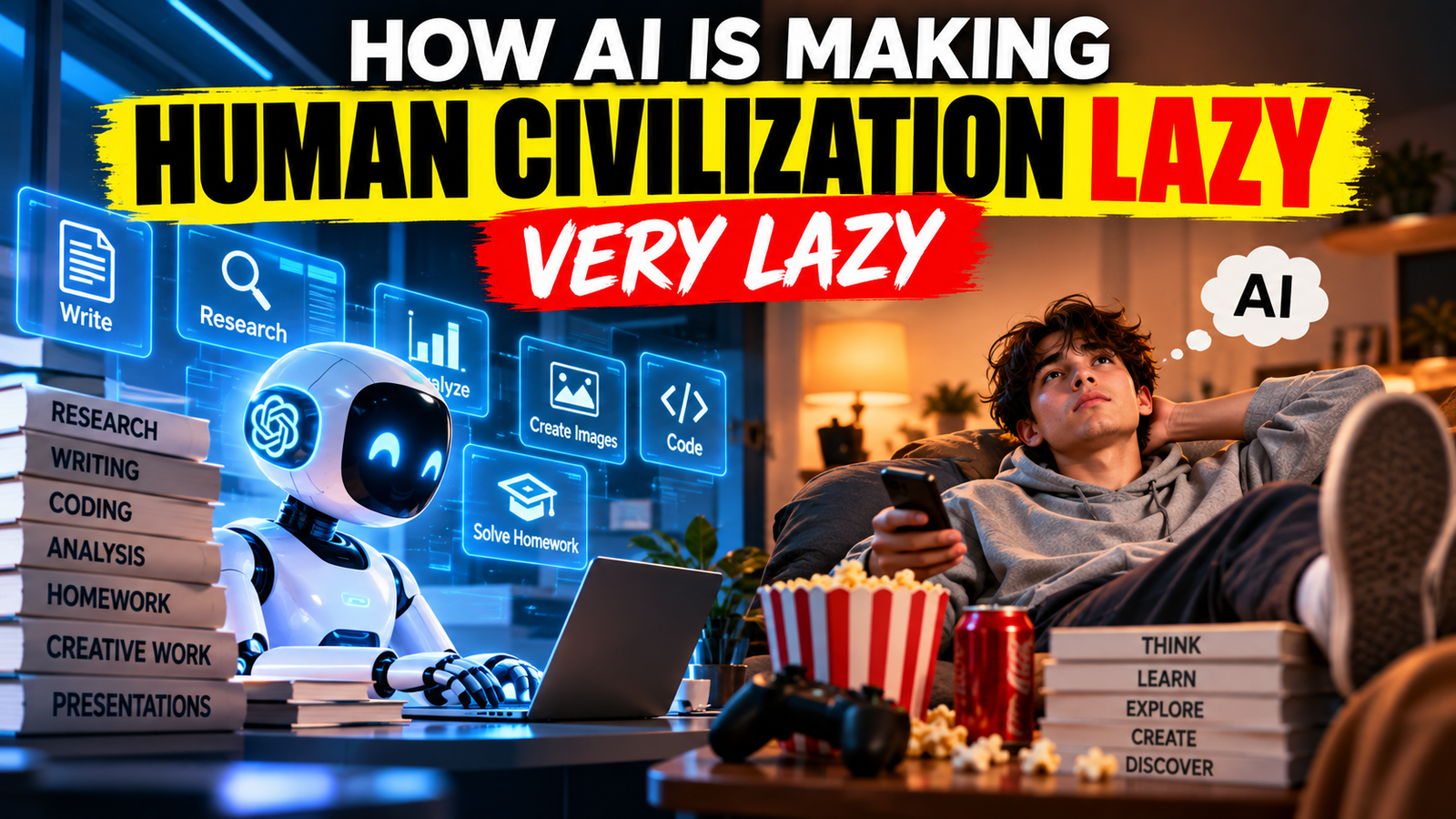
AI was created to make life easier. It can write, research, code, create images, summarize information, and solve problems in seconds.
But there’s a strange side effect to this whole revolution.
AI is making so many things so easy that humans are becoming less willing to put in any effort themselves.
The issue isn’t that AI is intelligent. The issue is that humans are increasingly using that intelligence as a replacement for their own effort.
From students asking AI to complete assignments to professionals asking it to write emails, create presentations, and analyze information, AI is slowly turning effort from a requirement into an optional choice.
And when effort becomes optional, laziness becomes extremely convenient.
AI Made Effort Optional
For thousands of years, getting information took work.
People read books, visited libraries, talked to experts, ran experiments, and spent hours researching.
Even simple knowledge wasn’t always easy to access.
The internet changed that.
Search engines made information available almost instantly.
But AI took another step.
Instead of giving you ten websites and asking you to figure things out, AI can read, summarize, organize, and explain information for you.
You can just type:
“Explain this to me.”
Or:
“Write this for me.”
Or:
“Research this topic.”
Or even:
“Make the entire project.”
That’s incredibly convenient.
But convenience has a hidden cost.
When people stop practicing a skill because a machine can do it instantly, the skill itself slowly gets weaker.
Search Engines Made Us Remember Less. AI Could Make Us Think Less.
Search engines already changed how we behave.
People don’t bother memorizing information anymore because they know they can just search for it whenever they need it.
That’s not necessarily a bad thing.
Humans have always created tools that extend our memory.
But AI goes further than traditional search.
Google gives you information.
AI takes that information and turns it into an answer for you.
That means you don’t always have to compare multiple sources, understand different perspectives, or build your own conclusion.
You can just ask the AI.
And that’s where the real concern starts.
AI Could Be Killing the Journey of Discovery
One of the most valuable parts of learning is the journey.
You start with one question.
You search for an answer.
During that search, you stumble onto another topic.
That topic leads to another.
Eventually, you know way more than you originally wanted to know.
AI can remove that journey.
You ask one question.
You get one organized answer.
Done.
It’s faster, but sometimes the journey itself was the education.
Humans don’t just learn from answers.
We learn from searching, getting confused, making mistakes, comparing ideas, and eventually figuring things out.
If AI always removes those steps, people might become extremely efficient at getting answers while becoming less experienced at finding them on their own.
AI Is Making Students Especially Vulnerable
Education is probably one of the clearest examples.
A student once had to read a chapter, understand it, and write an assignment.
Now an AI can generate the assignment in seconds.
A student can type:
“Write my 1,500-word history essay.”
Or:
“Solve these 20 questions.”
Or:
“Make my presentation.”
Or:
“Explain this chapter.”
That last request can be incredibly useful.
The first three become a problem if the student just submits the AI-generated work without understanding any of it.
There’s a massive difference between:
“Help me learn.”
and
“Do it for me.”
The first makes AI a teacher.
The second makes AI a replacement for learning.
A Student Can Become More Productive While Learning Less
This is one of the weirdest effects of AI.
Imagine a student who used to need three hours to finish an assignment.
With AI, the assignment takes ten minutes.
Technically, productivity has skyrocketed.
But what if those three hours were the actual learning process?
The student saved time.
But they may have also saved themselves from learning anything.
This raises an important question:
Should education measure how quickly someone can produce an answer, or how well they understand it?
AI makes that question more important than ever.
The Death of the First Draft
Writing is another example.
Before generative AI became mainstream, writers had to create their own first drafts.
The first sentence might have been terrible.
The introduction might have been boring.
The grammar might have been wrong.
The writer would edit it, rewrite it, and improve it.
That struggle was part of learning how to write.
Now AI can produce a polished first draft almost instantly.
That’s useful for professionals.
But it also creates a temptation.
Why struggle through writing when a machine can do it?
The danger is that people may eventually become better at telling AI what to write than writing themselves.
That’s a very different skill.
AI Could Create a Generation That Knows How to Ask—but Not How to Do
This might be one of the biggest long-term questions surrounding AI.
Imagine someone who can say:
“Build me an app.”
But doesn’t understand programming.
Someone who can say:
“Create a marketing strategy.”
But doesn’t understand customers.
Someone who can say:
“Analyze this financial report.”
But doesn’t understand finance.
Someone who can say:
“Explain this scientific concept.”
But has never studied the underlying science.
These people might become extremely good at interacting with AI.
But what happens when the AI makes a mistake?
They may not have enough knowledge to recognize it.
The More You Depend on AI, the More You Need Your Own Knowledge
This creates an interesting paradox.
The better AI becomes, the more useful it becomes.
But the better AI becomes, the easier it becomes to stop learning the things AI can do.
And that can create dependency.
A person who understands programming can use AI to write code faster.
A person who doesn’t understand programming may just copy whatever AI produces.
The first person is using AI as a multiplier.
The second person is using AI as a substitute.
That difference could become extremely important in the future.
AI Is Also Changing Creativity
AI image generators, video generators, music tools, and writing assistants have made creative production accessible to almost everyone.
Someone without Photoshop skills can create an image.
Someone without video-editing experience can create a video.
Someone without professional writing experience can produce an article.
That’s a huge technological achievement.
But there’s another problem.
If millions of people use similar AI systems, the internet could fill up with content that looks and sounds increasingly similar.
Perfect grammar.
Perfect lighting.
Perfect compositions.
Perfect marketing language.
Perfectly structured articles.
But maybe less individuality.
Human Creativity Was Never Perfect
Human creativity has always been messy.
Artists make strange decisions.
Writers produce unusual sentences.
Photographers capture imperfect moments.
Musicians experiment with sounds that shouldn’t work.
Some of the most memorable human creations came from mistakes.
AI tends to optimize.
Humans tend to experiment.
That’s why the goal shouldn’t be to make AI create everything perfectly.
The goal should be to use AI while keeping human originality at the center.
The Real Problem Isn’t AI
Blaming AI completely would be too simple.
Humans have always tried to reduce unnecessary effort.
We invented machines to reduce physical labor.
We invented calculators to reduce repetitive calculations.
We invented computers to process information faster.
We invented cars because walking long distances was inefficient.
Technology has always made certain things easier.
The real question is:
Which effort should disappear—and which effort should stay?
Removing boring repetitive work can be fantastic.
Removing the need to think can be dangerous.
AI Should Be a Bicycle for the Mind, Not a Replacement for the Mind
The best way to use AI might be to think of it as a collaborator.
Instead of saying:
“Write this entire article.”
You could say:
“Here are my ideas. Help me organize them and point out what I’m missing.”
Instead of:
“Do my homework.”
Ask:
“Teach me how to solve this problem.”
Instead of:
“Build my entire application.”
Ask:
“Help me understand why this code isn’t working.”
The difference is enormous.
In the first situation, AI replaces the human.
In the second, AI strengthens the human.
The Biggest Risk May Be Losing the Ability to Struggle
Struggle is uncomfortable.
But struggle is also how humans develop skills.
A child learns to walk by falling.
A programmer learns by debugging.
A writer improves by rewriting.
A musician improves by making mistakes.
A scientist learns from failed experiments.
An entrepreneur learns from bad decisions.
If AI removes every difficult moment, humans could lose some of the experiences that make them capable.
Not every struggle is valuable.
But some struggles absolutely are.
Learning requires friction.
If everything becomes effortless, learning itself can become shallow.
Will AI Make Human Civilization Really Lazy?
It certainly can.
If people use AI to avoid every mental challenge, every creative problem, and every learning opportunity, society could become increasingly dependent on machines.
People might know how to operate AI without understanding the systems behind it.
They might become excellent at consuming machine-generated information while becoming weaker at producing original knowledge.
But there’s another possible future.
AI could make humanity dramatically more capable.
A student could have a personal tutor available 24/7.
A programmer could have an intelligent coding partner.
A scientist could analyze enormous amounts of information.
A small business could access capabilities that previously required an entire team.
A writer could use AI as an editor.
A person with disabilities could use AI to overcome barriers that previously prevented participation.
The same technology can produce both outcomes.
The Future Belongs to People Who Can Think Without AI—and With AI
The people who benefit most from AI may not be those who completely reject it.
They may also not be the people who use it for absolutely everything.
The strongest people may be those who can do both.
They can think independently.
They can research.
They can write.
They can solve problems.
They understand fundamentals.
And then they use AI to multiply those abilities.
That combination is much more powerful than either extreme.
When AI gives you an answer, you should still be able to ask:
“Does this actually make sense?”
When AI creates something, you should still be able to ask:
“Can I make this better?”
And when AI makes a decision easier, you should still be capable of asking:
“Should I make this decision at all?”
Final Thoughts
AI isn’t necessarily making humanity lazy.
It’s making laziness incredibly convenient.
And that’s the important distinction.
For the first time, humans can outsource enormous parts of their intellectual workload with almost no effort.
That can be liberating.
It can also become addictive.
If we use AI to remove meaningless repetitive work, humanity could become more productive.
If we use AI to remove thinking itself, humanity could become more dependent.
The future will probably contain both outcomes.
AI will make some people extraordinarily capable.
And it may make others extraordinarily dependent.
The difference won’t simply be the technology.
It will be how we choose to use it.
Because perhaps the greatest danger of AI isn’t that machines become too intelligent.
Perhaps it’s that humans become too comfortable with not being intelligent themselves.
