

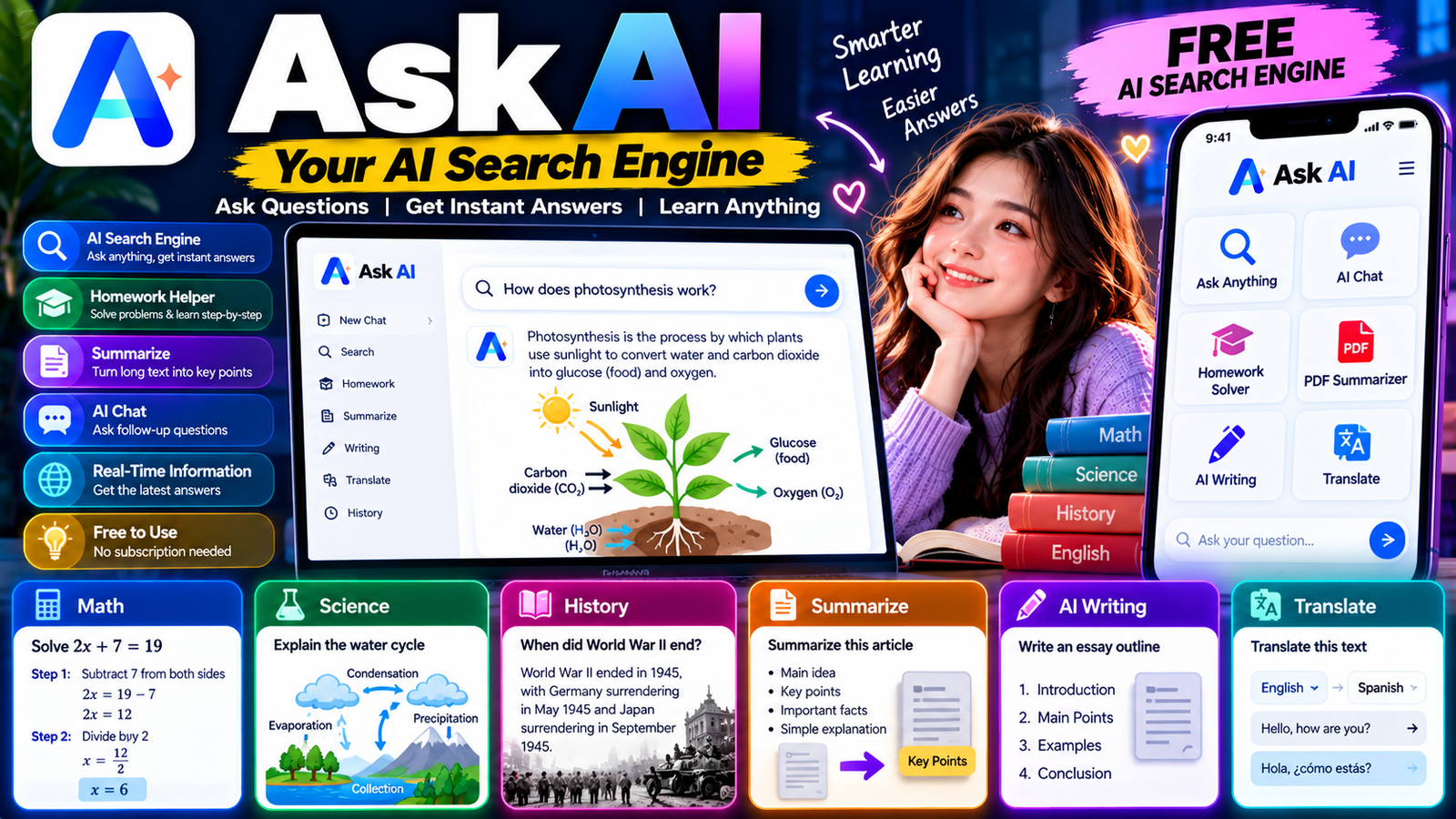
Ever searched for something online and ended up opening ten different tabs just to understand one simple answer? That’s where an AI answer engine like Ask AI comes in. Instead of typing keywords and sifting through pages of links, you just ask a question in plain English and get an AI-generated response.
Ask AI is often described as a free AI search engine and question-answering tool. It handles general questions, research queries, and even homework help in a conversational way.
But what exactly is Ask AI? How does it work? Is it really free? And can you actually use it for school or research?
Here’s the full breakdown.
What Is Ask AI?
Ask AI is an AI-powered question-answering and search tool. You type a question in normal language and get an AI-generated answer.
Instead of typing a few keywords into Google, you can write a full question like:
What causes a solar eclipse?
or:
Explain photosynthesis in simple words.
The system processes your question and generates a response based on its underlying language and search technology.
QuestionAI describes its Ask AI service as a free AI search engine that answers questions in real time and gives instant responses.
One thing to note: the name “Ask AI” is used by several different products. In this article, I’m talking about the Ask AI service connected to QuestionAI—not every app that happens to use that name.
How Does Ask AI Work?
Ask AI works a lot like other AI answer engines.
You enter a question, the system figures out what you’re asking, picks out the important parts, and then generates a natural-language response.
The big difference from traditional search is how the information is presented.
A regular search engine gives you a page of links. An AI answer engine tries to give you the answer directly.
For example, instead of searching:
“World War 2 end year”
you could ask:
“When did World War II end and which countries were involved?”
The second question gives more context, so the AI understands what you actually want to know.
How to Use Ask AI
Using Ask AI is pretty straightforward.
Step 1: Open Ask AI
Go to the Ask AI page linked to QuestionAI.
Step 2: Type Your Question
Enter your question in the search box.
You can ask something simple or give a detailed question. Examples:
- What is artificial intelligence?
- Who invented the telephone?
- Explain Newton’s laws.
- How does photosynthesis work?
- What is the difference between RAM and ROM?
- Help me understand this math problem.
Step 3: Submit It
Send your question and wait for the response.
Step 4: Read and Check the Answer
Read the explanation carefully. For anything important—academic, financial, medical, or legal—verify the answer with reliable sources. Don’t just assume the AI is always right.
What Can You Ask Ask AI?
One of the best things about an AI question-answering system is that you’re not limited to one subject.
You can ask about:
- Science
- Math
- History
- Geography
- Technology
- Business
- Literature
- English
- General knowledge
- Current topics
- Homework
- Research
- Writing
- Everyday questions
The official Ask AI page presents it as a general-purpose question-answering engine, not something limited to one topic.
Ask AI for Homework
One of the most useful applications of Ask AI is education.
Students can enter homework questions and ask the AI to explain the answer.
For example:
“Solve 3x + 5 = 20 and explain every step.”
Instead of just asking for the final number, asking for an explanation makes the response more useful for learning.
Ask AI sits alongside QuestionAI’s broader homework-helper tools, so you can use AI for questions across different subjects.
But students should use AI as a learning assistant, not just a way to copy answers.
Ask AI Math Solver
Ask AI can also handle math questions.
You can type questions involving:
- Arithmetic
- Algebra
- Equations
- Word problems
- Geometry
- Basic calculus
- Mathematical concepts
For example:
“Solve 2x + 7 = 19 and explain the steps.”
A good prompt tells the AI whether you want just the answer or a detailed explanation.
Instead of:
“Solve this.”
try:
“Solve this equation step by step and explain why each step is necessary.”
That gives the AI more context about what you actually want.
Ask AI for Science Questions
Science is another area where an AI question-answerer can help.
You can ask things like:
- How does photosynthesis work?
- Why is the sky blue?
- What is DNA?
- Explain gravity.
- What is an ecosystem?
- How does the human digestive system work?
For tricky topics, ask the AI to explain at a specific level.
For example:
“Explain quantum mechanics like I’m a high school student.”
That can make complicated subjects way easier to understand.
Ask AI for History
Ask AI can also answer historical questions.
You could ask:
- When did World War II end?
- Who was Alexander the Great?
- What caused the French Revolution?
- Explain the Industrial Revolution.
- What happened during the American Civil War?
For historical research, always double-check important dates and claims using books, academic sources, museums, or reputable reference sites.
AI-generated answers can sometimes contain mistakes.
Ask AI for Research
AI answer engines are handy during the early stages of research.
Instead of searching through dozens of pages right away, you can first ask an AI to explain a topic and point out the key concepts.
For example:
“Explain the main causes of climate change and give me the key topics I should research.”
That can help you build a research plan.
Then you can dig into individual topics using authoritative sources.
Ask AI as an AI Search Engine
The term AI search engine is used more and more for tools that mix search-like discovery with conversational AI.
Ask AI is marketed by QuestionAI as a free AI search engine where you can ask questions naturally instead of relying only on keyword searches.
That’s especially useful when your question is complicated.
For example, instead of searching:
“best laptop programming 32gb 2026”
you could ask:
“What should I look for in a laptop for Android Studio and Unity development, and why does RAM matter?”
The AI can then organize the response around your actual question.
Is Ask AI Free?
The Ask AI page connected to QuestionAI currently describes the service as a free AI search engine.
But “Ask AI” is also used by multiple independent apps and services, and their pricing can be totally different.
For example, different Ask AI-branded apps on the App Store and Google Play have their own free tiers, subscriptions, or premium features.
So if you see an Ask AI app asking for payment, make sure it’s the same product you meant to use.
Ask AI vs Google Search
Ask AI and Google Search are good for different things.
Google Search is built to help you find webpages, websites, news, and other online resources.
Ask AI is built to give you a conversational answer to your question.
For example:
Google Search:
You search “how does photosynthesis work” and browse through websites.
Ask AI:
You ask “Explain photosynthesis in simple language” and get a direct explanation.
For research, traditional search engines are still super useful because you can inspect original sources.
For quick explanations, conversational AI can be more convenient.
Ask AI vs ChatGPT
Ask AI and ChatGPT both let you interact with AI using natural language, but they’re not exactly the same type of product.
ChatGPT is a broad AI assistant designed for conversation, writing, reasoning, coding, and tons of other tasks.
Ask AI’s QuestionAI version is positioned more around asking questions and getting answers through an AI search/question-answering experience.
The best choice depends on what you’re trying to do.
If you want a broad AI assistant, ChatGPT might be better.
If you want a straightforward question-answering or AI-search experience, Ask AI could be worth a try.
Ask AI vs Question AI
This comparison can be confusing because Ask AI and QuestionAI are closely connected in the service discussed here.
The official Ask AI page actually describes QuestionAI as also being known as ASK AI.
QuestionAI itself offers a broader set of study tools, including Ask AI, a calculator, and Test ACE, plus subjects like Math, Biology, History, Social Science, English, and Business.
So if you search for Ask AI, Question AI, or AI homework help, you’ll probably run into overlapping features.
Can Ask AI Answer Current Questions?
This is an important distinction.
AI systems can get information in different ways. Some rely mainly on their trained knowledge, while others also search the web.
The current Ask AI page says the service provides answers in real time, but you should still verify anything that depends on rapidly changing events.
For things like:
- Breaking news
- Live sports scores
- Current prices
- Government announcements
- Product availability
- Recent scientific developments
always check the latest primary or authoritative source.
Ask AI for Writing
AI question-answering tools can also help with writing tasks.
You can ask for:
- Paragraph ideas
- Topic explanations
- Outlines
- Grammar help
- Rewriting
- Summaries
- Brainstorming
- Essay planning
For example:
“Give me five ideas for an article about renewable energy.”
Then you can take those ideas and turn them into your own original work.
If you’re using AI for school assignments, follow your school’s rules about AI-assisted writing.
Ask AI for Summaries
Another useful application is summarization.
You can provide text and ask the AI to turn it into simpler notes.
For example:
“Summarize this chapter in 10 bullet points.”
Or:
“Explain this paragraph in simple English.”
That’s handy when you’re studying a lot of information.
How to Get Better Answers From Ask AI
The quality of an AI response often depends on the quality of your question.
Instead of asking:
“Tell me about computers.”
try:
“Explain how a computer’s CPU, RAM, and storage work together in simple language for a beginner.”
You can also specify:
- Your experience level
- Desired answer length
- Preferred format
- Whether you want examples
- Whether you want step-by-step reasoning
- Whether you want a summary
Example Prompt
“Explain the water cycle for a 10-year-old using five simple bullet points and one real-world example.”
That’s much more specific than just asking:
“What is the water cycle?”
Is Ask AI Accurate?
No AI answer engine should be treated as perfectly accurate.
Ask AI’s official page uses words like “accurate” and “reliable” when describing its service, but those are product claims—not a guarantee that every answer will always be correct.
AI systems can make mistakes, misunderstand questions, or give incomplete information.
This matters especially for:
- Medical information
- Legal questions
- Financial decisions
- Academic research
- Technical instructions
- Current events
For important info, verify the answer using trustworthy sources.
Advantages of Ask AI
There are several reasons people might prefer an AI answer engine.
Simple Question Format
You can ask questions naturally instead of learning special search syntax.
Fast Responses
AI-generated answers can save time when you just need a basic explanation.
Useful for Learning
Students can ask follow-up questions and request simpler explanations.
Broad Topics
Ask AI can be used for general knowledge, education, research, and everyday questions.
Conversational Experience
You can phrase questions like you’d ask another person.
Limitations of Ask AI
Ask AI has limitations too.
AI Can Make Mistakes
Generated answers shouldn’t automatically be treated as facts.
Important Information Requires Verification
For high-stakes questions, always check reliable sources.
Search and AI Are Different
An AI-generated answer isn’t always a replacement for reading the original source.
Product Names Can Be Confusing
Several unrelated apps use names like Ask AI, AI Chat, and Ask AI Chatbot, so check the developer and website before installing an app or buying a subscription.
Is Ask AI Good for Students?
Ask AI can be useful for students when it’s used as a learning assistant.
Instead of asking:
“Give me the answer.”
a better approach is:
“Help me understand how to solve this problem and explain each step.”
That encourages learning instead of just copying an answer.
Students can use AI to:
- Understand difficult concepts
- Review lessons
- Generate practice questions
- Summarize notes
- Explain homework problems
- Brainstorm project ideas
- Improve understanding of unfamiliar topics
How to Use Ask AI Responsibly
AI is most useful when it supports your own thinking.
A good workflow is:
Ask → Understand → Verify → Practice
First ask the question.
Then read and understand the response.
Next, verify important information.
Finally, try solving a similar problem yourself.
That approach makes AI a study tool rather than an answer-copying machine.
Ask AI on Mobile
The name “Ask AI” is used by several mobile apps, including ones on Apple’s App Store and Google Play. Their features and pricing vary by developer.
One current Google Play listing for an app called Ask AI: AI Chat & Image describes features like AI chat, writing assistance, studying, coding, image generation, and voice chat.
Because multiple products share similar names, always check the developer name and app description before downloading.
Ask AI for Everyday Questions
You don’t have to use AI only for school or research.
You can ask everyday questions like:
- How do I write a professional email?
- Explain this technology.
- Give me dinner ideas.
- Help me plan a trip.
- Explain this error message.
- Rewrite this paragraph.
- Give me ideas for a project.
- Explain this word.
- Help me understand a complicated topic.
The conversational format makes it easy to ask follow-up questions.
Tips for Getting Better Results
Here are some simple tips that can improve your experience.
Be Specific
Give the AI enough information to understand your goal.
Give Context
Explain who the answer is for and what you’re trying to accomplish.
Ask for Examples
Examples often make difficult explanations easier to understand.
Request a Specific Format
You can ask for bullet points, a table, a short explanation, or a detailed guide.
Ask Follow-Up Questions
If the first answer is confusing, ask:
“Can you explain that more simply?”
or:
“Give me an example.”
Frequently Asked Questions
What is Ask AI?
Ask AI is an AI-powered question-answering service associated with QuestionAI. It lets users ask questions in natural language and get AI-generated answers.
Is Ask AI free?
The QuestionAI Ask AI page currently describes the service as a free AI search engine. However, other apps using the Ask AI name may have their own pricing and subscriptions.
Can Ask AI solve homework?
Yes. Ask AI can be used for homework-related questions and explanations, while QuestionAI also provides dedicated study and homework tools.
Can Ask AI solve math problems?
You can use Ask AI to ask math questions and request explanations or step-by-step help.
Is Ask AI the same as ChatGPT?
No. They’re separate products, though both provide conversational AI experiences.
Is Ask AI an AI search engine?
The QuestionAI service explicitly describes Ask AI as a free AI search engine and question-answering tool.
Can I use Ask AI for research?
Yes. It can be useful for understanding topics, generating research ideas, and getting initial explanations. Important claims should still be verified using authoritative sources.
Is Ask AI accurate?
It can provide useful answers, but no AI system should be assumed to be error-free. Verify important information before relying on it.
Can students use Ask AI?
Yes. It can be used as a study and learning assistant for explanations, homework questions, and research.
Final Thoughts
Ask AI is built around a simple alternative to traditional search: instead of searching for a collection of webpages first, you can ask a question and get a conversational answer.
For students, it can be useful for understanding homework and difficult concepts. For researchers and everyday users, it can provide a quick starting point for exploring unfamiliar topics.
The most effective way to use Ask AI is not to treat it as an unquestionable source of truth. Use it to learn, explore, organize ideas, and understand difficult subjects, then verify important information with reliable sources.
With the growing number of products using names like Ask AI, Question AI, and AI Chat, it’s also important to check which specific service you’re using before assuming that features, pricing, or privacy policies are the same.
