
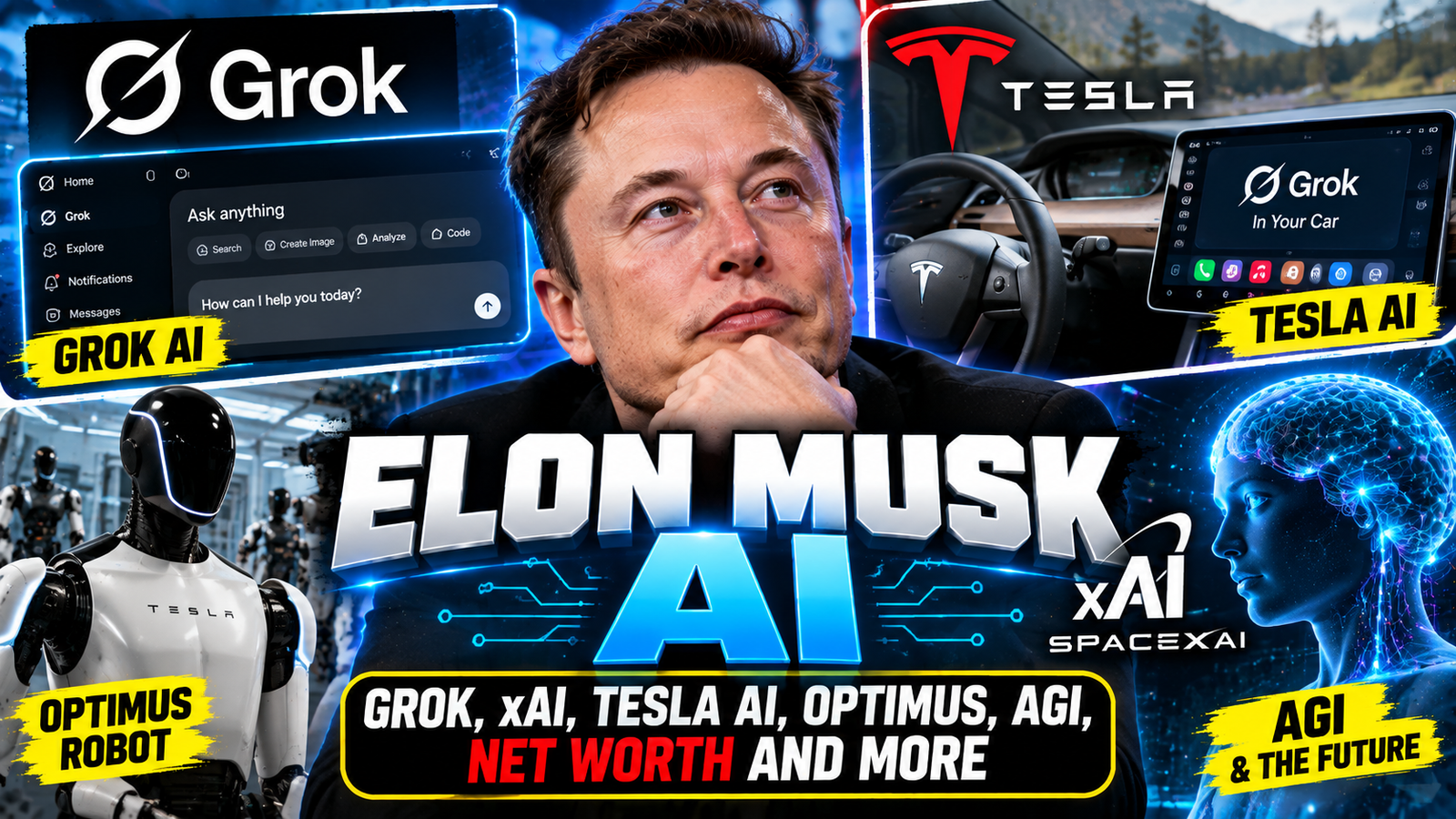
Elon Musk’s AI story is not just about one chatbot. It is a sprawling network of models, chips, cars, robots, satellites, and software agents. If you only know Grok as the witty assistant inside X, you are seeing a small slice of a much larger plan.
As of September 27, 2026, that plan has a new shape. xAI, the company Musk founded in 2023, is now part of SpaceX after being acquired in February 2026. The AI arm operates under the SpaceXAI name. Its latest flagship model, Grok 4.7, arrived on September 21, 2026, and it is being positioned as a serious tool for coding, knowledge work, and long-running agentic tasks.
This article breaks down the entire ecosystem — what Grok is now, how SpaceXAI fits in, what Tesla is doing with AI, where Optimus stands, how AGI fits into the conversation, and what all of this could mean next.
What Does “Elon Musk AI” Actually Mean?
“Elon Musk AI” is not an official product name. It is an umbrella phrase people use to describe the many artificial intelligence projects connected to Musk. That includes:
- Grok
- SpaceXAI
- xAI
- Tesla AI
- Tesla Full Self-Driving
- Optimus
- Custom AI chips
- AI data centers
- Grok Imagine
- Grok Build
- Grok Bot
- AI voice technology
- AI-powered robotics
- Long-term AGI research
The most familiar piece is Grok. You can use it on the web, through iOS and Android apps, and inside X. Newer versions also power coding tools, image and video generation, and autonomous agents.
But Grok is only one part of a much bigger machine.
How It All Started: xAI and the First Grok
Musk announced xAI in 2023. The stated goal was ambitious: build AI that helps humanity understand the universe. By November 2023, the first Grok was revealed. It was presented as a conversational AI with a sense of humor and real-time access to information through X.
At first, it looked like a cheeky alternative to other chatbots. But the product evolved fast.
Grok moved from simple conversation into a broader platform that can handle:
- General chat
- Reasoning
- Coding
- Research
- File analysis
- Image creation
- Video creation
- Voice interaction
- Tool use
- Agentic tasks
- Automation
- Website and app development
The 2026 releases show just how far this has gone.
SpaceX Buys xAI: The Birth of SpaceXAI
One of the biggest turning points came in February 2026, when SpaceX announced it had acquired xAI. After that, the company began using the SpaceXAI identity across its website, documentation, and announcements.
This merger matters because it joins two very different worlds.
SpaceX brings:
- Rockets
- Satellites
- Starlink
- Space infrastructure
- Massive computing and engineering demands
The former xAI brings:
- Large language models
- AI research
- Grok
- AI agents
- AI infrastructure
- Image and video generation
- Developer APIs
Put together, Musk’s AI ambitions now stretch from software on your phone to hardware in orbit. That is a very different scale from a normal AI startup.
Grok 4.7: The Current Flagship
As of late September 2026, Grok 4.7 is the newest major Grok model. SpaceXAI introduced it on September 21, 2026, calling it a frontier model focused on coding, agentic work, and knowledge tasks.
Here is the quick breakdown:
| Feature | Grok 4.7 |
|---|---|
| Model | Grok 4.7 |
| Context window | 500,000 tokens |
| Input | Text + images |
| Output | Text |
| Reasoning | Yes |
| Coding | Yes |
| Agentic tasks | Yes |
| Knowledge work | Yes |
| API access | Yes |
| Grok Build | Yes |
| Cursor | Yes |
SpaceXAI lists standard API pricing starting at $2 per million input tokens and $6 per million output tokens. Requests above 200,000 tokens fall under different pricing.
The company also says Grok 4.7 was trained with a longer reinforcement-learning run aimed at tasks that can take hours to complete. That is a shift from quick answers to sustained problem-solving.
Grok Is No Longer Just a Chatbot
Modern Grok is built to do far more than reply to prompts. According to official documentation, it can handle:
- Asking and answering questions
- Brainstorming
- Writing
- Problem solving
- Image generation
- Video generation
- Voice conversations
- File analysis
- PDF analysis
- Spreadsheet analysis
- Code analysis
- Tool connections
- Calendar access
- Email access
- AI agents
It is available on the web, iOS, and Android. That places Grok in the same broad category as advanced AI assistants that combine chat, multimodal input, tools, and autonomous workflows.
Grok Imagine: Images and Video
Grok Imagine is the creative side of the ecosystem. It handles AI image and video generation.
SpaceXAI has released separate Imagine models for images and videos, including Imagine Image 2.0 and Imagine Video 1.5. The company says Imagine Video 1.5 can work with text, image, and voice references, and can generate video up to 1080p.
This means the Musk AI ecosystem is no longer text-only. Users can move through a chain:
Idea → Text → Image → Video → Voice → Finished content
That opens doors for:
- YouTube thumbnails
- Social media posts
- Advertising
- Storytelling
- Gaming
- Marketing
- Education
- Product demos
- Creative projects
Grok Voice: Talking Instead of Typing
Voice has become a key part of the system. SpaceXAI has continued developing voice models, including Grok Voice Transcribe 2.0, released in September 2026.
Grok can act as a conversational voice assistant, not just a text chatbot. That becomes especially important inside vehicles, where drivers need hands-free interaction.
Grok on X
Grok has a close relationship with X. It is integrated into the platform and can be used to ask questions, solve problems, and interact with information flowing through the network. X’s own help documentation describes Grok as an AI assistant powered by xAI’s large language models.
This gives Grok a unique environment. X contains a huge amount of fast-moving public conversation, which can be useful for:
- Breaking news research
- Trending topics
- Public discussions
- Social media analysis
- Finding conversations
- Summarizing information
- Generating posts
That said, real-time information should still be checked against reliable primary sources when accuracy matters.
Grok Build: AI That Helps You Build Software
Grok Build is one of the most interesting pieces of the ecosystem. It is designed around AI-assisted software development.
It can help users create software, work with code, and operate as a more autonomous coding agent. In 2026, SpaceXAI expanded Grok Build beyond traditional coding help. New features include:
- Agents
- Subagents
- Memory
- Workflows
- MCP tools
- Long-running tasks
- Project files
- Automated development
- Website creation
- Application development
The September 2026 changelog shows Grok 4.7 becoming available inside the product, along with improvements to subagents, memory, and development workflows.
The shift is subtle but important. It is moving from:
“Write this code for me.”
to:
“Build this project with me.”
Grok Bot: AI That Does Work
SpaceXAI also introduced Grok Bot, an AI-agent system built to perform work rather than just respond to prompts.
The company describes it as a system of persistent AI teammates that can have their own computer, work with tools, and keep operating beyond a single chat session.
This changes the interaction model. Instead of telling an AI every small step, a user can give an agent a larger goal and let it work through multiple steps.
Potential tasks include:
- Customer support
- Research
- Procurement
- Business operations
- Data processing
- Software development
- Repetitive office work
- Tool-based workflows
SpaceXAI has reported using Grok Bot internally for customer support after combining its support operations with Cursor. The company said support ticket volume increased substantially while it avoided adding the additional headcount it estimated would otherwise have been necessary. Those figures are company-reported, so they should be treated as SpaceXAI’s own account rather than an independent measurement.
Tesla: The Physical Side of Musk’s AI
Tesla represents the hardware and real-world side of Musk’s AI strategy. While SpaceXAI focuses heavily on digital intelligence, Tesla is building AI systems meant to operate in the physical world.
Tesla’s AI work includes:
- Full Self-Driving
- Neural networks
- Computer vision
- AI training infrastructure
- Custom AI processors
- Optimus humanoid robots
- In-vehicle AI
- Grok integration
- Autonomous systems
Tesla’s own reporting says the company completed the final chip design of its next-generation AI5 inference processor in April 2026.
This shows an important distinction. Grok is primarily a general-purpose AI system. Tesla’s driving and robotics systems are designed to perceive and act in the physical environment.
Grok Inside Tesla Cars
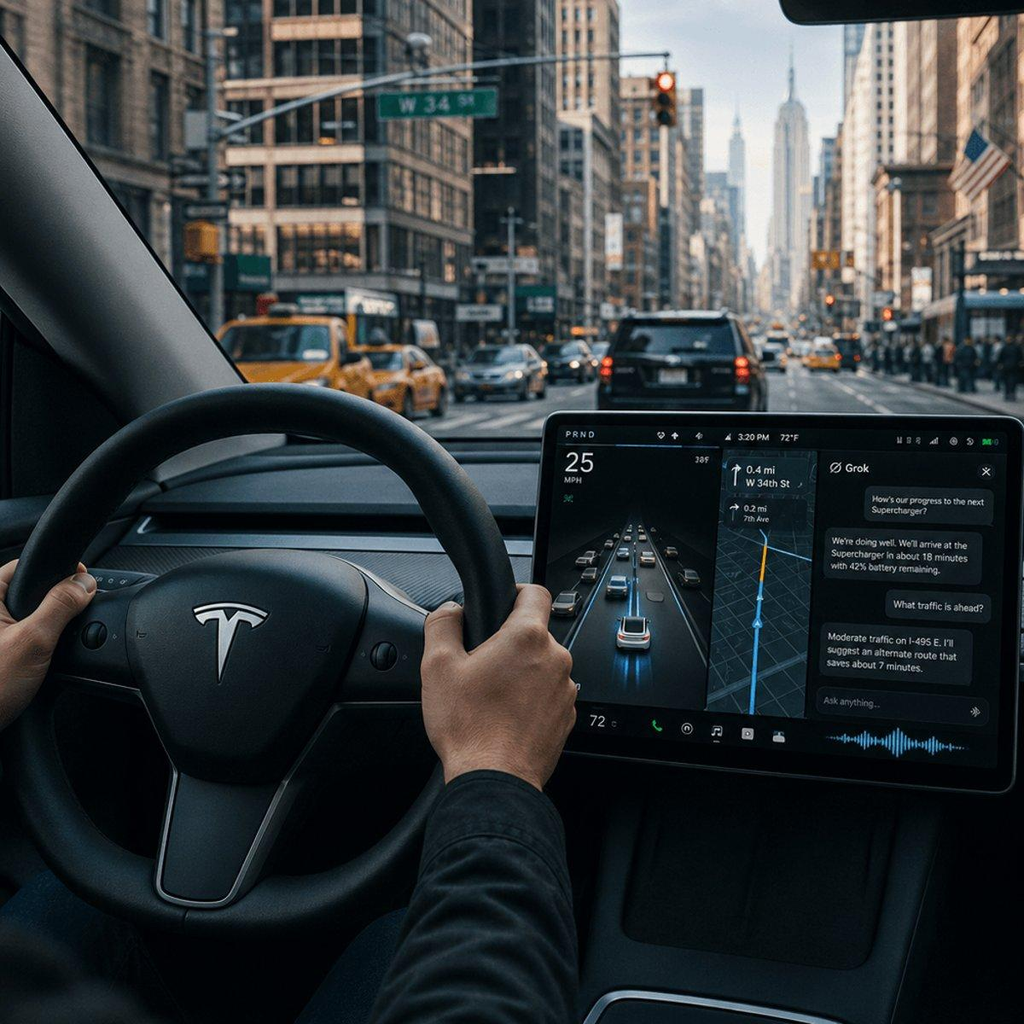
Grok has become part of Tesla’s in-car software experience. Tesla’s official documentation describes Grok as an AI assistant that can operate hands-free in supported vehicles.
Depending on the vehicle configuration and region, drivers can use Grok for:
- General conversation
- Navigation
- Phone calls
- Text messaging
- Music searches
- Climate controls
- Vehicle questions
- Vehicle settings
- Glove-box controls
Tesla’s manual also explains that the Assistant personality is required for vehicle commands, while other personalities can be used for general conversation.
This is a significant step. The AI is no longer confined to a phone or computer screen. It can interact with the vehicle itself.
Grok can also interact with navigation. A Tesla driver can use voice commands to ask Grok to navigate to locations and change destinations.
Tesla’s documentation describes navigation commands alongside other vehicle functions. For example, a driver can ask Grok to find a destination instead of manually entering it into the touchscreen.
This points to the broader direction of AI-powered vehicles:
Driver → Natural language → AI → Vehicle action
Instead of memorizing specific commands or navigating complicated menus, users can communicate naturally.
Tesla and SpaceXAI: A Deeper Connection
The integration between Tesla and SpaceXAI is strategically important.
Tesla disclosed in January 2026 that it had agreed to invest approximately $2 billion in xAI’s Series E preferred stock and that the companies had established a framework for evaluating AI collaborations. Tesla said the relationship was intended to help deploy AI products and services into the physical world at scale.
After SpaceX acquired xAI, the relationship became even more significant. This creates the possibility of deeper connections between:
- Grok
- Tesla vehicles
- FSD
- Optimus
- AI chips
- Robotics
- Space infrastructure
- AI computing
Tesla AI Chips
AI requires enormous computing power. Tesla has therefore invested heavily in custom hardware.
The company’s 2026 reporting discusses the development of its next-generation AI5 inference processor and a large-scale chip-fabrication strategy intended to support growing AI demand.
Custom chips allow Tesla to optimize hardware specifically for its neural networks and autonomous-driving workloads. Instead of relying entirely on general-purpose processors, Tesla can design hardware around its own requirements.
Optimus: AI Meets Robotics
Optimus is Tesla’s humanoid-robot project. The idea is to combine AI perception, planning, movement, and robotics into a physical machine capable of operating in environments designed for humans.
The broader vision connects several technologies:
AI model + computer vision + robotics + actuators + sensors + custom chips
A humanoid robot requires much more than a chatbot. It needs to:
- See the environment
- Understand objects
- Understand instructions
- Plan actions
- Control movement
- Maintain balance
- Manipulate objects
- React to unexpected situations
That makes robotics one of the hardest applications of artificial intelligence.
AI and Full Self-Driving
Tesla’s Full Self-Driving technology is another major part of Musk’s AI strategy.
Tesla reported billions of cumulative FSD-supervised miles in its 2026 investor materials and continues to develop neural-network-based driving systems. The company explicitly notes that FSD (Supervised) still requires active driver supervision and does not make the vehicle autonomous.
That distinction is important. The phrase “AI-powered driving” does not automatically mean a vehicle can operate without human supervision. Tesla’s current system remains a supervised driving technology.
Does Elon Musk Own an AI Company?
Elon Musk founded xAI, the company behind Grok.
In February 2026, SpaceX announced that it had acquired xAI. As a result, the AI organization is now part of the larger SpaceX ecosystem and operates publicly under the SpaceXAI identity.
This means Musk’s AI projects are increasingly connected with his other technology companies.
Elon Musk AI and AGI
Artificial General Intelligence, usually called AGI, is one of the most discussed long-term goals in the AI industry.
Musk has repeatedly discussed advanced AI and AGI. However, it is important to distinguish between:
- Current AI products
- AI research
- Predictions about future AI
- Claims about AGI
- Actual demonstrated AGI
Grok 4.7 is a highly capable AI model, but it should not automatically be described as AGI. Current systems remain specialized artificial intelligence systems despite their ability to perform a very wide range of tasks.
Can Grok Create Websites and Apps?
Yes.
The 2026 Grok ecosystem includes development tools capable of helping users create websites, applications, games, and interactive projects.
SpaceXAI’s product announcements describe Build Mode as a way to create and share websites, apps, games, and interactive dashboards.
This is particularly interesting for independent developers. Instead of starting every project from an empty Android Studio, VS Code, or web-development workspace, users can increasingly use AI as a development partner.
Grok for Documents and Files
Grok also supports file-based workflows. Users can upload:
- PDFs
- Images
- Spreadsheets
- Code
- Audio
- Other files
Then ask Grok to analyze, summarize, or extract information from them.
This makes the product useful beyond casual conversation. For example, a user could provide a large document and ask for:
- A summary
- Key points
- Data extraction
- Questions and answers
- Rewriting
- Analysis
- Structured information
Grok for Businesses
The SpaceXAI ecosystem has expanded into business use.
Grok Bot for Enterprise is designed for organizations that want AI agents working with business tools.
The company’s 2026 releases also include integrations and model availability across platforms such as Microsoft Foundry, Amazon Bedrock, Gemini Enterprise Agent Platform, and GitHub Copilot.
This means developers and businesses do not necessarily have to use Grok only through the consumer chatbot. They can increasingly integrate Grok into existing software ecosystems.
Elon Musk AI and Coding
Coding has become one of Grok’s major areas of development.
Grok 4.7 is specifically positioned around coding and knowledge work. Its capabilities include:
- Code generation
- Debugging
- Software engineering
- Long-running tasks
- Tool use
- Agentic coding
- Repository work
- Development workflows
Grok 4.7 is also available through the API and coding environments including Grok Build and Cursor.
This makes Musk’s AI strategy particularly relevant to developers.
Elon Musk AI and AI Agents
One of the biggest changes in AI during 2026 has been the movement from chatbots toward agents.
A chatbot generally waits for a question. An agent can potentially:
- Plan
- Use tools
- Execute multiple steps
- Inspect results
- Correct mistakes
- Continue working
- Interact with software
Grok Bot and Grok Build are examples of this direction within the SpaceXAI ecosystem.
This could eventually change how people use computers. Instead of opening ten different applications and manually completing a workflow, a user could describe the desired result and allow an AI agent to coordinate the work.
Grok Memory
Memory has also become an important part of the Grok ecosystem.
SpaceXAI announced memory capabilities for Grok Build in September 2026.
Persistent memory can allow an AI development agent to retain useful project information between sessions, rather than starting from zero every time.
For developers, this can be especially useful for remembering:
- Coding conventions
- Architecture decisions
- Project structure
- Development preferences
- Important project facts
- Previous work
The company’s September 2026 updates specifically describe memory improvements in Grok Build.
Elon Musk AI and Content Creation
AI image and video generation are becoming another major part of the ecosystem.
Grok Imagine supports creative generation, while SpaceXAI has continued releasing new image and video models.
Creators can use AI for:
- YouTube thumbnails
- Concept art
- Marketing graphics
- Social media posts
- Short videos
- Product visuals
- Storyboards
- Advertising concepts
- Character designs
The technology also makes it possible to move between different media formats.
A written idea can become an image. An image can become a video. A script can become voice content. That is one reason multimodal AI has become such a major part of the current AI industry.
Privacy and Safety
The expansion of AI also creates important questions around privacy, security, and misuse.
AI systems can process:
- Personal messages
- Documents
- Images
- Voice
- Business information
- Code
- Calendar information
- Social-media content
Users should therefore understand what information they are sharing and which permissions they have enabled.
Tesla’s documentation says conversations with Grok in its vehicles are anonymous to Tesla and not associated with the vehicle, while usage limits and availability can vary.
At the same time, AI systems remain capable of producing incorrect or misleading information. For important decisions, AI-generated answers should be checked against reliable sources.
Controversies Around Grok
Grok has also faced controversy around content moderation and misuse.
In September 2026, reporting described allegations involving AI-generated illegal sexual material and lawsuits concerning the misuse of Grok. Elon Musk has disputed awareness of certain alleged outputs, while xAI has taken legal action against users accused of generating such material.
These incidents illustrate a broader problem facing the entire generative-AI industry: powerful image and text-generation systems can be abused. The technology therefore requires safeguards, moderation systems, and responsible use.
What Makes Elon Musk’s AI Strategy Different?
Musk’s AI strategy connects digital AI with physical machines.
A simplified picture looks like this:
- Grok → Intelligence
- Tesla → Vehicles
- Optimus → Robots
- SpaceX → Space infrastructure
- Starlink → Connectivity
- AI chips → Computing
- Grok Bot → AI agents
The goal is not simply to create a chatbot. It is a much broader ecosystem where AI can operate across software and physical devices.
Elon Musk AI vs Traditional Chatbots
Traditional chatbots mainly focus on conversation. Modern Musk-associated AI products increasingly attempt to combine conversation with action.
| Traditional AI Chatbot | Musk AI Ecosystem |
|---|---|
| Text conversation | Text + voice + image + video |
| Answers questions | Can use tools |
| Short sessions | Persistent agents |
| Text output | Multimedia output |
| Computer screen | Vehicles and robots |
| Manual workflows | Automated workflows |
| General assistance | Coding + agents + physical AI |
This does not mean every Grok product can perform every task. Capabilities depend on the specific product, model, plan, and device.
Why Elon Musk Is Investing So Heavily in AI
There are several documented strategic connections across Musk’s companies.
Tesla is building AI into vehicles and robotics. SpaceXAI is developing general-purpose models and AI agents. SpaceX provides enormous infrastructure requirements and a path toward integrating AI with physical systems.
The overall direction is therefore increasingly centered on artificial intelligence as a foundational technology rather than a standalone software category.
What Could Elon Musk AI Look Like in the Future?
Future developments could involve increasingly capable AI agents, more advanced vehicle assistants, better robotics, and stronger integration between AI models and physical machines.
Possible areas include:
AI Personal Assistants
Grok could become increasingly capable of managing personal workflows, information, and applications.
AI Developers
Coding agents may be able to build increasingly complete applications with less manual programming.
AI Vehicles
Voice-based AI could become a standard interface for navigation, communication, and vehicle controls.
Humanoid Robots
Optimus could become an important test of whether AI can successfully move from digital environments into physical environments.
AI Infrastructure
Large-scale AI models will continue requiring massive amounts of computing power, networking, and specialized chips.
Is Elon Musk AI Free?
Grok is available with free access, but SpaceXAI also offers paid plans with higher limits and additional capabilities.
The official Grok documentation describes Grok as free to start, with paid SuperGrok plans providing increased usage limits and additional access.
API access is separately usage-based.
For developers, Grok 4.7 API pricing currently starts at $2 per million input tokens and $6 per million output tokens under the standard lower-context pricing tier.
Can I Use Grok on Android?
Yes.
The official Grok documentation states that Grok is available on Android as well as iOS and the web.
This makes the AI accessible across:
- Android phones
- iPhones
- Web browsers
- X
- Supported Tesla vehicles
- Developer platforms
Is Grok the Same as ChatGPT?
No.
Grok and ChatGPT are separate AI products developed by different organizations.
Grok is developed by SpaceXAI and is closely integrated with the broader Musk technology ecosystem.
ChatGPT is developed by OpenAI.
Both can perform tasks such as writing, reasoning, coding, and analysis, but their models, interfaces, tools, integrations, and product strategies are different.
Is Grok 4.7 the Latest Grok Model?
As of September 27, 2026, yes, Grok 4.7 is the latest major Grok model announced by SpaceXAI.
It was introduced on September 21, 2026.
SpaceXAI describes it as its most capable model for coding and knowledge work.
Elon Musk AI FAQ
What is Elon Musk AI?
“Elon Musk AI” is a general term for the artificial-intelligence projects associated with Elon Musk, especially Grok and the broader SpaceXAI ecosystem, as well as Tesla’s AI, robotics, and autonomous-driving work.
What is Grok?
Grok is an AI assistant developed by SpaceXAI. It can answer questions, write, reason, analyze files, create images and videos, use voice, and connect with tools.
Who owns Grok?
Grok was developed by xAI, which SpaceX acquired in February 2026. The company now operates under the SpaceXAI identity.
What is the latest Grok model?
As of September 2026, the latest major model is Grok 4.7.
Can Grok generate images?
Yes. Grok includes image-generation capabilities through Grok Imagine.
Can Grok generate videos?
Yes. SpaceXAI’s Imagine ecosystem includes video-generation models, including Imagine Video.
Can Grok write code?
Yes. Coding is one of the major use cases for Grok 4.7 and Grok Build.
Can Grok build websites?
Grok’s Build ecosystem includes tools designed to create websites, applications, games, and interactive dashboards.
Is Grok available in Tesla cars?
Yes, in supported Tesla vehicles and regions. Tesla’s official documentation describes Grok as an in-car AI assistant capable of conversation and selected vehicle commands.
Can Grok control a Tesla?
On supported vehicles, Grok can perform certain commands such as navigation, phone calls, media controls, and climate adjustments when the appropriate Assistant functionality is enabled.
Is Tesla’s Full Self-Driving fully autonomous?
Tesla’s current documentation describes FSD (Supervised) as requiring active driver supervision and states that it does not make the vehicle autonomous.
What is Grok Bot?
Grok Bot is an AI-agent product designed to perform work using tools and a persistent computing environment rather than simply answering one prompt at a time.
What is Grok Build?
Grok Build is an AI development environment designed to help users build software and work on coding projects with AI agents.
What is Tesla AI5?
AI5 is Tesla’s next-generation AI inference processor. Tesla reported completing the final chip design in April 2026.
Is Elon Musk building AGI?
Musk has discussed AGI as a long-term AI objective, but current Grok models should not automatically be described as AGI. They are highly capable AI systems rather than demonstrated human-level general intelligence.
Final Thoughts
The phrase “Elon Musk AI” now represents a much larger technology ecosystem than it did when Grok first appeared in 2023.
The journey has moved from an experimental chatbot to a collection of AI products involving:
- Grok 4.7 → AI models
- Grok Imagine → Images and video
- Grok Voice → Voice interaction
- Grok Build → Coding
- Grok Bot → AI agents
- Tesla Grok → In-car AI
- Tesla AI → Autonomous-driving technology
- AI5 → Custom AI hardware
- Optimus → Physical AI and robotics
The September 2026 launch of Grok 4.7 and the continuing expansion of Grok Bot, Grok Build, and Tesla integration show how quickly the ecosystem is evolving.
The most important shift may be the move from AI that simply answers to AI that can increasingly create, operate, use tools, and interact with physical machines.
That is ultimately what makes Elon Musk’s AI strategy one of the most closely watched technology stories of 2026.
