

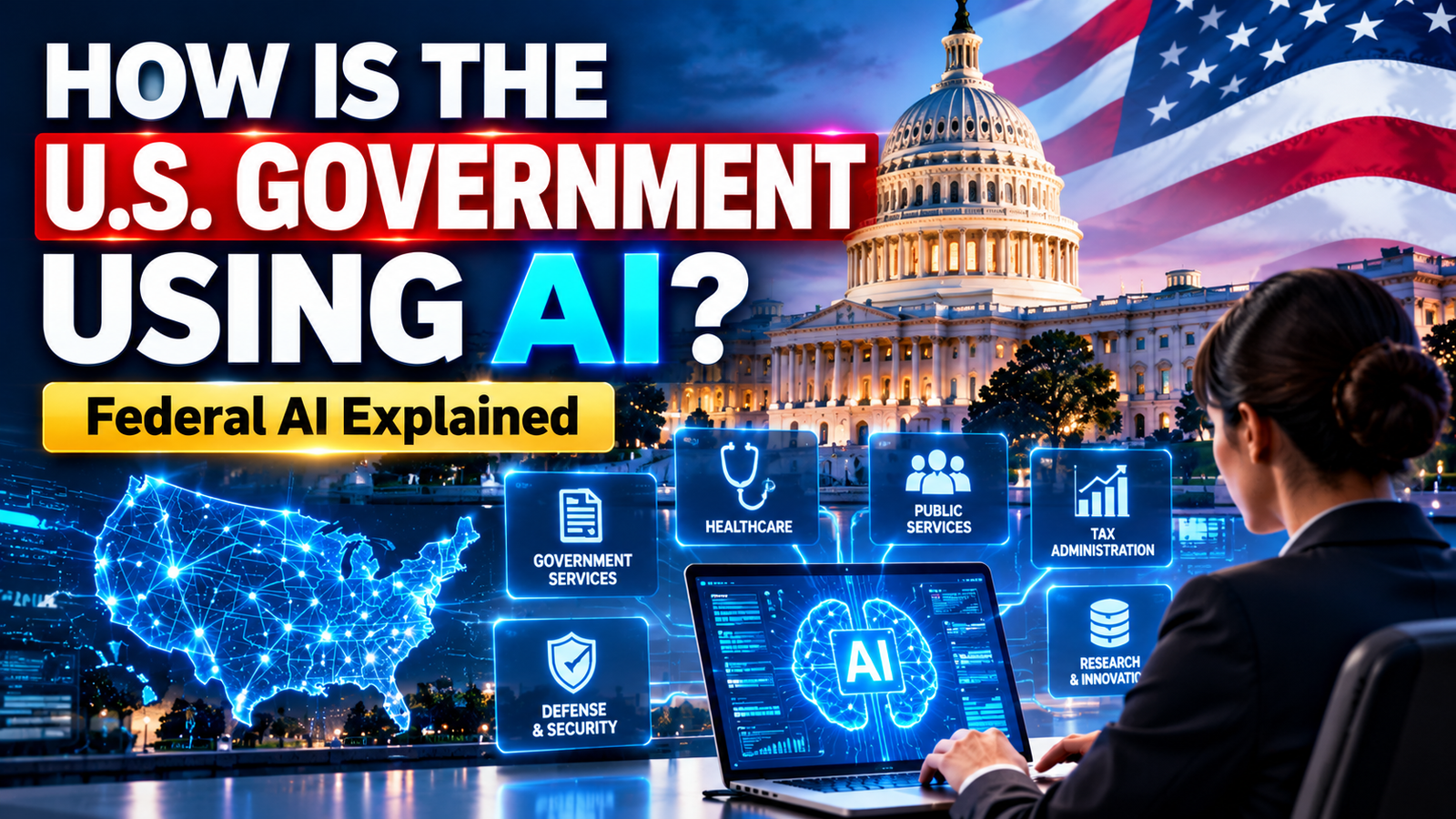
Artificial intelligence is becoming part of everyday operations across the U.S. federal government. Agencies are using AI to analyze information, automate repetitive work, assist employees, improve public services, process documents, support scientific research and help people interact with government.
This is much broader than chatbots. AI is being used in areas ranging from tax administration and veterans’ services to space research, government procurement, cybersecurity and national security.
As of 2026, federal agencies are also expanding access to commercial AI systems while developing their own tools and governance programs. The Government Accountability Office (GAO) reported that federal agencies more than doubled their AI use between 2023 and 2024.
How Is the U.S. Government Using AI?
Some of the major areas include:
- Government search and public services
- Healthcare
- Veterans’ benefits
- Tax administration
- Fraud detection
- Scientific research
- Space exploration
- Defense and national security
- Cybersecurity
- Document processing
- Customer service
- Software development
- Data analysis
- Administrative automation
The exact technology differs between agencies. Some systems use traditional machine learning, while others use generative AI, computer vision, predictive analytics or AI agents.
Quick Overview
| Area | Example |
|---|---|
| Public services | America.gov AI search |
| Healthcare | Medical documentation and image analysis |
| Veterans | Claims and benefits processing |
| Taxes | Audit selection and taxpayer assistance |
| NASA | Scientific research and mission support |
| Defense | Decision support, logistics and intelligence |
| Diplomacy | Information and document analysis |
| Justice | AI-assisted operational tools |
| Administration | Document review and automation |
| Coding | AI development assistants |
| Cybersecurity | Threat detection and analysis |
| Research | Large-scale data analysis |
The most important point is that AI is generally being introduced as a tool for specific government tasks, rather than as one universal system controlling the federal government.


America.gov and GSA AI
1. America.gov Is Using AI to Help People Find Government Information
One of the newest public-facing examples is America.gov.
Launched in September 2026, America.gov is designed to act as a digital front door to federal information and services.
Instead of making users figure out which agency operates a particular program, America.gov allows people to ask questions in their own words.
GSA says America.gov combines information from more than 29,000 government websites with AI-enhanced search technology.
The website says answers come from official government websites and include links to the original sources.
Users can ask questions about government services, request step-by-step guidance, and upload certain government PDFs for help understanding them.
America.gov also supports English, Spanish and French, as well as voice input.
America.gov Is More Than a Chatbot
The important idea is that America.gov connects conversational AI with government information.
Instead of searching:
Agency → website → menu → form → instructions
the intended experience is:
Question → AI search → explanation → official source
The service is also planned to expand in 2027. America.gov says future capabilities will go beyond answering questions and include completing forms, tracking progress and organizing government-related tasks.
2. GSA Is Building AI Infrastructure for Federal Agencies
The General Services Administration (GSA) is playing a major role in expanding federal AI adoption.
GSA currently operates USAi, described as a FISMA Moderate AI tool providing access to multiple models, a unified API framework and usage tracking.
GSA is also using procurement agreements to make AI products available to federal agencies.
In September 2026, GSA announced a OneGov agreement making OpenAI’s ChatGPT models available to federal agencies through discounted, consumption-based pricing, with the agreement expected to take effect October 1, 2026.
GSA’s AI program also includes AI governance, procurement guidance and a cross-agency AI Community of Practice.
This means the government is not relying on a single AI provider or one model.
Different agencies can use different technologies depending on their mission, security requirements and data.


Healthcare, Veterans Affairs and IRS AI
3. The VA Is Using AI in Healthcare
The Department of Veterans Affairs (VA) is another major area of federal AI adoption.
The VA has reported AI use across healthcare, benefits and operational activities.
One notable application is ambient AI scribe technology.
During a medical appointment, an AI system can help generate clinical documentation from the conversation. The healthcare professional remains responsible for reviewing the resulting documentation.
AI is also being explored for medical imaging and other healthcare workflows.
GAO reported that VA’s AI use cases increased substantially between 2023 and 2024, including work involving medical imaging and clinical information.
AI and Veterans’ Benefits
AI can also assist with administrative work surrounding veterans’ benefits.
The goal in these cases is often to process information faster, identify relevant material and reduce repetitive work.
This does not mean an AI model automatically determines every veteran’s eligibility.
The distinction between AI assistance and final government decision-making remains important.
4. The IRS Uses AI for Taxes and Fraud Detection
The Internal Revenue Service (IRS) has been using AI for several years.
According to a March 2026 GAO report, the IRS had 126 active AI use cases in its inventory as of June 2025.
These included applications for:
- Audit selection
- Tax compliance
- Fraud detection
- Taxpayer assistance
- Voicebots
- Chatbots
- Taxpayer-service operations
- Document and information analysis
GAO reported that 18 of the IRS’s 43 tax-compliance and fraud-focused use cases were operational as of June 2025.
The agency was also using public-facing voicebots and chatbots to answer taxpayer questions.
GAO reported that these taxpayer-service bots had more than 5 million sessions during the 2024 filing season and nearly 25 million sessions during the 2025 filing season.
AI and Tax Audits
AI can help identify patterns in large quantities of tax information.
Rather than manually examining every possible case in the same way, analytical systems can help identify returns or situations that warrant additional attention.
The final tax process still operates under federal law and IRS procedures.


NASA, Defense, Diplomacy and Justice AI
5. NASA Uses AI for Space and Scientific Research
NASA has been using artificial intelligence and machine learning in scientific and engineering work.
Applications include:
- Scientific data analysis
- Satellite imagery
- Mission planning
- Autonomous systems
- Modeling
- Pattern recognition
- Software development
- Planetary research
AI is particularly useful when researchers have to analyze enormous quantities of scientific data.
Instead of manually examining every data point, machine-learning systems can help identify patterns and relationships that researchers can investigate further.
NASA’s use of AI therefore includes both operational applications and research-oriented work.
6. The Department of Defense Uses AI
The Department of Defense (DoD) is using AI for a very different set of problems.
Defense applications can include:
- Intelligence analysis
- Logistics
- Planning
- Decision support
- Cyber operations
- Autonomous systems
- Command and control
- Information analysis
GAO reported in 2026 that federal agencies are using AI in areas including weapon-system effectiveness, veterans’ services and administrative operations.
AI can process large quantities of sensor, image, text and logistical information much faster than traditional manual workflows.
However, defense applications also introduce significant questions involving security, reliability, accountability and human control.
7. The State Department Uses AI
The U.S. Department of State can use AI to help employees analyze large amounts of information.
Potential applications include:
- Translation
- Document analysis
- Research
- Information-environment analysis
- Media analysis
- Summarization
Diplomatic organizations deal with huge volumes of international information every day.
AI can help employees organize that information and identify material that deserves further attention.
The technology does not eliminate the need for diplomats and policy professionals to interpret events and make decisions.
8. The Department of Justice Uses AI
The Department of Justice (DOJ) has also developed an extensive AI-use program.
The department maintains a public inventory of AI use cases covering systems at different stages of development and deployment.
The uses vary by component and mission.
AI can assist with activities such as:
- Document analysis
- Information processing
- Research
- Investigative support
- Administrative operations
- Data analysis
The DOJ’s AI work demonstrates another major federal pattern: AI is often being incorporated into existing workflows rather than replacing an entire government process.


Government Automation, Cybersecurity and AI Risks
9. AI Is Automating Government Documents
Federal agencies process huge quantities of paperwork.
AI can help with:
- Document classification
- Information extraction
- Summarization
- Form processing
- Routing
- Searching
- Compliance checks
- Data entry assistance
This may not sound as exciting as humanoid robots, but it is potentially one of the most practical government applications of AI.
A system that reduces hours of repetitive document work can allow employees to concentrate on cases that require human judgment.
GSA itself highlights uses ranging from document review to risk management as part of its AI program.
10. AI Is Being Used for Cybersecurity
Cybersecurity teams have to monitor enormous amounts of information.
AI can help identify patterns in:
- Network activity
- Security logs
- Malware
- Suspicious behavior
- Authentication events
- System alerts
The advantage is speed.
A security team may have thousands or millions of events to analyze. AI can help prioritize the events that deserve human investigation.
However, the same technology can also be used by attackers.
Generative AI can make phishing and other forms of cyber abuse easier to automate, which means federal agencies have to consider both AI-enabled defense and AI-enabled threats.
11. Government Employees Are Using Generative AI
AI is also becoming an employee productivity tool.
Federal workers can use approved AI systems for tasks such as:
- Drafting
- Summarization
- Research
- Coding
- Data analysis
- Brainstorming
- Document preparation
GSA’s USAi program is specifically intended to give federal employees access to AI capabilities while providing a government framework for their use.
The important limitation is that sensitive government information cannot simply be placed into any public AI service.
Agencies need appropriate security, privacy and procurement controls.
12. AI Is Being Used to Automate Repetitive Tasks
A major reason federal agencies are interested in AI is straightforward:
Some government processes involve large amounts of repetitive work.
GSA’s 2026 Elimination, Optimization and Automation Handbook focuses on process improvement and automation so employees can spend more time on mission-critical responsibilities.
AI can become one component of that automation strategy.
For example:
Old workflow:
Employee → read document → extract information → classify → enter data → move to next document
AI-assisted workflow:
AI → extract and classify → employee reviews → system continues processing
The second workflow can potentially reduce the amount of manual work while keeping a person involved where appropriate.


AI Risks, Human Oversight and Future of Government AI
13. Does AI Make Government Decisions Automatically?
Not necessarily.
One of the biggest misconceptions about government AI is that an AI model automatically makes every decision.
In reality, many systems are designed to assist employees.
For example, an AI system might:
- Process information.
- Identify a pattern.
- Produce a recommendation or summary.
- Send the result to a government employee.
- Have the employee review the information.
- Complete the official process under applicable rules.
The amount of human involvement depends on the agency and use case.
High-impact applications require particular attention to accountability, privacy, security and accuracy.
14. Accuracy Is a Major Challenge
AI can make mistakes.
Generative AI can produce inaccurate information, while predictive systems can produce false positives or miss important cases.
The federal government therefore has to evaluate AI systems before and during deployment.
America.gov itself warns users that AI-generated answers can be incomplete, incorrect or outdated.
The same basic principle applies inside government:
AI output should not automatically be treated as truth.
15. Privacy and Security Matter
Federal agencies often handle sensitive information.
That includes:
- Medical records
- Tax information
- Veterans’ records
- Immigration information
- Financial data
- Law-enforcement information
- National-security information
AI systems therefore need appropriate privacy and security controls.
GSA’s 2026 AI directive emphasizes assessment, procurement, monitoring, governance, risk management, transparency and lifecycle accountability.
America.gov’s privacy policy also explains that its AI searches government websites in a secure, sandboxed environment and warns users to avoid sending sensitive personal information unnecessarily.
16. Will AI Replace Government Workers?
There is no single answer.
Some repetitive tasks can be automated.
At the same time, many government AI applications are explicitly designed to assist employees rather than eliminate human responsibility.
The likely effect will differ significantly by occupation.
An employee whose job contains a large amount of repetitive document processing may see substantial changes.
A worker whose job depends heavily on judgment, negotiation, field work or direct interaction may use AI more as an assistant.
GAO has also identified workforce skills as a challenge. In its 2026 IRS review, GAO found that staffing reductions had affected the agency’s ability to support and develop AI tools and that the IRS had not developed a workforce plan for its AI-related skills needs.
17. The Government Is Buying AI From Private Companies
Federal AI adoption is not limited to software developed internally.
GSA is using governmentwide procurement agreements to give agencies access to commercial AI products.
In September 2026, GSA announced a OneGov agreement with OpenAI for discounted, consumption-based access to ChatGPT models for federal agencies.
GSA has also announced other AI-related procurement partnerships, including offerings focused on reporting, analytics, workflow automation and decision support.
This creates a mixed ecosystem:
Federal AI = government-built systems + commercial AI + traditional software + human expertise.
18. What Could Government AI Look Like Next?
The next phase may move from AI that simply answers questions toward AI that helps people complete government tasks.
America.gov provides an early example.
Its current service focuses on answering questions and helping people navigate government information.
Its stated 2027 plans go further, with capabilities intended to help users complete forms, track progress and organize government tasks.
The broader direction can be summarized as:
Search → Understand → Apply → Complete → Track
If these capabilities expand successfully, AI could become an interface connecting citizens to multiple government services.


6How Is the U.S. Government Using AI? Final Guide
Final Thoughts
So, how is the U.S. government using AI?
The answer is much broader than government chatbots.
Federal agencies are already using AI for healthcare, veterans’ benefits, tax administration, fraud detection, scientific research, space operations, defense, cybersecurity, document processing, customer service, coding and administrative automation.
The IRS provides one of the clearest examples of large-scale operational use, with GAO reporting 126 active AI use cases in its June 2025 inventory.
GSA is building shared AI infrastructure and procurement options for federal agencies. The VA is applying AI to healthcare and benefits-related workflows. NASA uses AI in science and space-related activities. Defense agencies use AI for mission-related analysis and support. And America.gov is bringing conversational AI directly to the public.
At the same time, AI adoption comes with real challenges.
Government agencies have to deal with accuracy, privacy, cybersecurity, bias, transparency, workforce skills and accountability.
The most important development may therefore not be the government’s use of AI itself, but how deeply AI becomes integrated into everyday government services.
For citizens, the experience could eventually become much simpler:
Ask a question → receive guidance → complete the necessary form → submit it → track the result.
For government employees, AI could increasingly handle repetitive information-processing tasks while people concentrate on cases that require judgment, expertise and accountability.
The U.S. government’s AI story is therefore still developing. Some systems are already operational, some remain in development, and others are being tested.
What is clear is that AI has moved from being a purely experimental technology to becoming part of the federal government’s digital infrastructure.
Frequently Asked Questions
How is the U.S. government using AI?
The U.S. government uses AI for healthcare, taxes, benefits, document processing, scientific research, defense, cybersecurity, customer service, software development, fraud detection and government information services.
Which agency uses AI?
Many federal agencies use AI. Examples include GSA, IRS, VA, NASA, DOJ and the Department of Defense.
Does the IRS use AI?
Yes. GAO reported 126 active IRS AI use cases as of June 2025, including audit selection, taxpayer assistance, fraud detection and tax-compliance applications.
Does the VA use AI?
Yes. VA has reported AI applications across healthcare, benefits and operational activities.
What is America.gov AI?
America.gov is a federal digital gateway using AI-enhanced search to help people find government information and services. GSA says it combines information from more than 29,000 government websites.
Is the U.S. government using ChatGPT?
Federal agencies can obtain commercial AI products through GSA procurement programs. GSA announced a OneGov agreement with OpenAI in September 2026 for discounted, consumption-based access to ChatGPT models for federal agencies.
Will AI replace government employees?
AI can automate some tasks, but many federal applications are designed to assist employees rather than independently replace human decision-making. The effect will vary depending on the job and agency.
What are the biggest risks of government AI?
Major concerns include inaccurate outputs, privacy, cybersecurity, bias, transparency, accountability and insufficient AI-related skills.
Is government AI already being used?
Yes. GAO reports that federal agencies have significantly expanded their AI use, with documented applications across many agencies and missions.
