
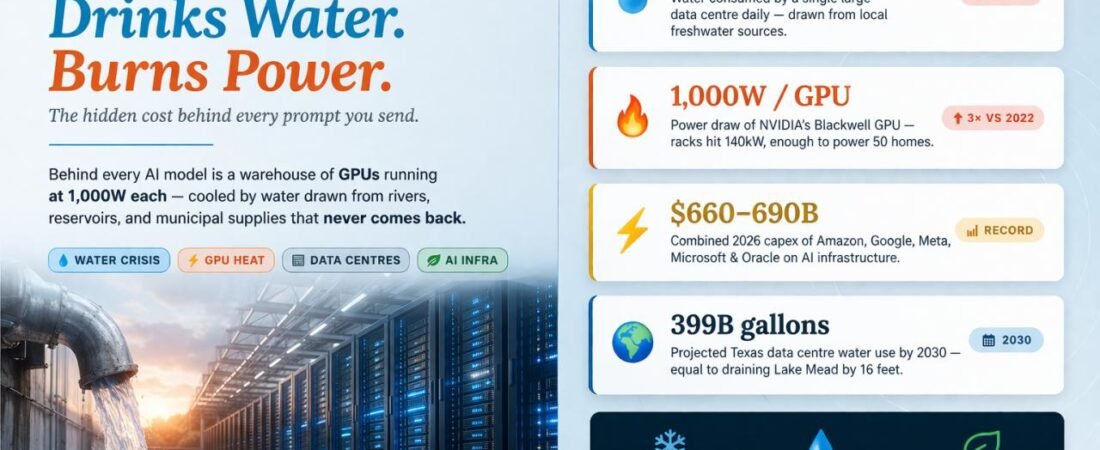
Artificial intelligence has become one of the fastest-growing technologies in the world. Millions of people now use AI chatbots, image generators, coding assistants, search tools, and other AI-powered applications every day.
But there is an environmental question that many people don’t think about:
How much water does AI use?
The answer is more complicated than simply saying that every AI question uses a certain number of milliliters of water.
AI itself does not literally “drink” water. The water is primarily associated with the data centers, cooling systems, electricity generation, and hardware manufacturing required to train and operate AI models.
Some research has estimated that training a large model such as GPT-3 could consume millions of liters of water when both direct and indirect water consumption are considered. However, modern data centers are also becoming significantly more efficient, and some newer facilities use closed-loop or low-water cooling systems.
A 2025 research article in Communications of the ACM estimated that training GPT-3 could consume about 5.4 million liters of water in total, including approximately 700,000 liters of direct on-site water consumption under the study’s assumptions. The same research estimated that GPT-3’s operational water consumption could correspond to roughly 500 mL for every 10–50 medium-length responses, depending on where and when the model was deployed.
That does not mean every modern ChatGPT conversation uses that much water. AI hardware, models, data centers, cooling technologies, and electricity sources have changed considerably.
So, how much water does AI actually use today?
Let’s break it down.
Quick Answer: How Much Water Does AI Use?
There is no single number that applies to every AI system.
AI’s water footprint can range from relatively small amounts for an individual request to millions or billions of liters when considering large-scale training and data-center operations.
The biggest factors include:
- The size and type of AI model
- How much computing power is required
- Whether the task is text, image, video, reasoning, or agentic AI
- The efficiency of the hardware
- The cooling system used by the data center
- The climate where the data center operates
- The source of electricity
- Whether water used to generate electricity is included
- Whether semiconductor manufacturing is included
- Whether we measure water withdrawal or actual water consumption
This is why claims such as “one AI question uses X bottles of water” should be treated carefully.
Different studies can produce dramatically different results because they are measuring different parts of the AI water footprint.
Why Does AI Need Water?
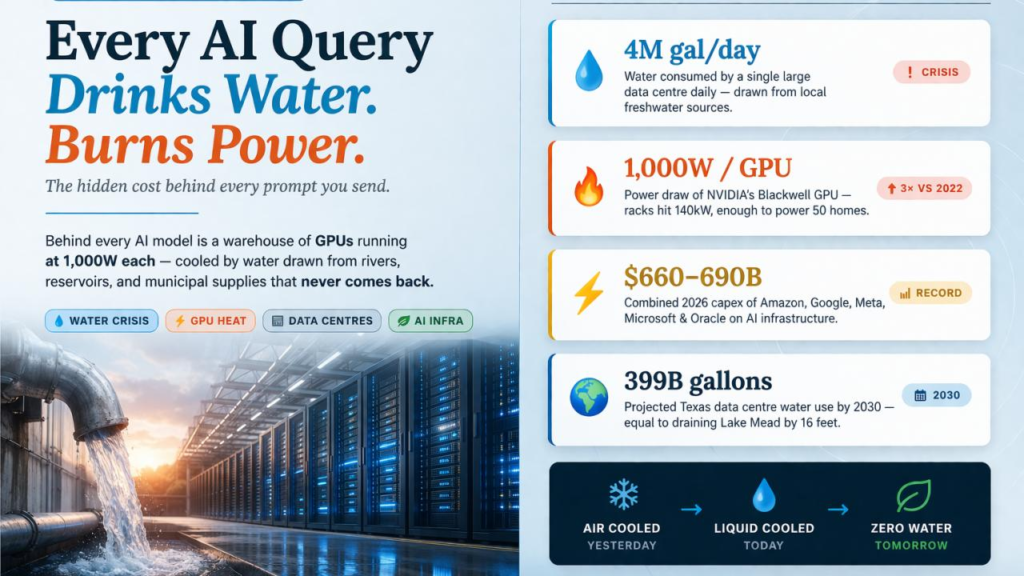
AI models run on computers located inside data centers.
Those computers contain powerful processors, particularly GPUs and other AI accelerators.
When these chips perform calculations, they consume electricity and produce heat.
That heat has to be removed.
If the heat is not removed efficiently, the servers can become too hot and may malfunction or shut down.
This creates the connection between AI and water.
A simplified process looks like this:
AI request → servers → electricity → heat → cooling system → water consumption
However, this is only part of the story.
Water can also be associated with producing the electricity that powers the data center and manufacturing the chips and servers themselves.
Researchers therefore often divide AI’s water footprint into multiple categories.
The Three Major Sources of AI Water Use
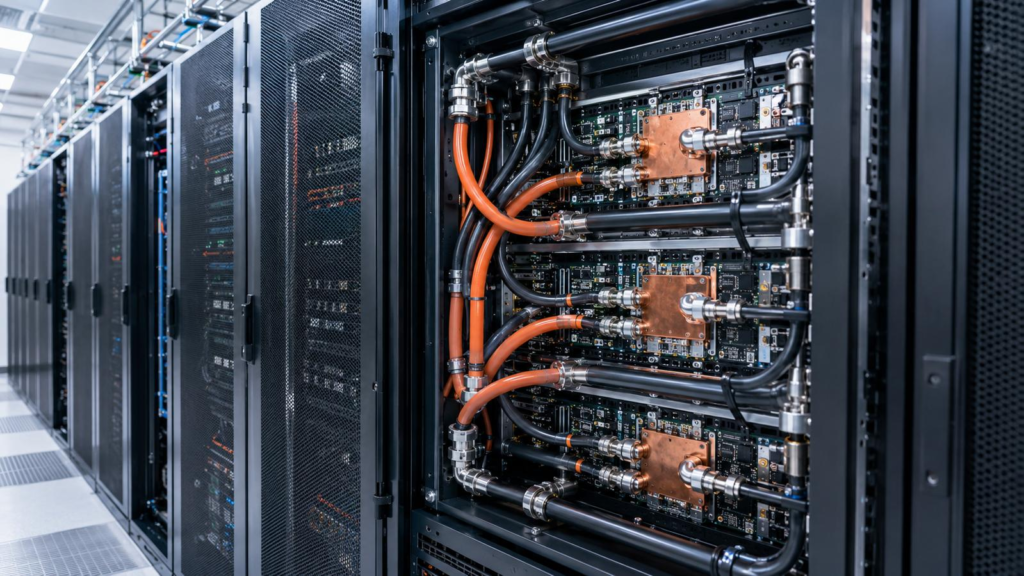
AI’s water footprint can broadly be divided into three areas:
1. Data-center cooling
This is the most obvious source.
Data centers need cooling systems to remove heat from servers.
Some facilities use cooling towers and evaporative cooling, where water is consumed as part of the cooling process.
Other facilities increasingly use technologies such as:
- Direct-to-chip liquid cooling
- Closed-loop cooling
- Immersion cooling
- Air cooling
- Heat exchangers
- Recycled or reclaimed water
The amount of water required can therefore vary dramatically between facilities.
The U.S. Department of Energy describes Water Usage Effectiveness (WUE) as a data-center metric measuring water consumption relative to IT equipment energy use, typically expressed in liters per kilowatt-hour.
2. Water used to generate electricity
AI servers need electricity.
But electricity generation can also have a water footprint.
For example, some power plants use water for cooling.
That means an AI model can have an indirect water footprint even if the data center itself uses relatively little water.
This is one reason why two studies can calculate very different water footprints for the same AI workload.
One calculation may count only water directly consumed at the data center.
Another may also include water associated with producing the electricity used by the servers.
The 2025 Communications of the ACM research describes these as different parts of AI’s operational water footprint.
3. Manufacturing AI chips and servers
There is another part of the story that is often overlooked.
AI requires sophisticated semiconductor chips.
Manufacturing semiconductor wafers requires large amounts of highly purified water.
Water is used during several manufacturing processes, including cleaning and processing semiconductor materials.
Servers also require other components, manufacturing facilities, and supply chains.
Therefore, if someone asks for the total water footprint of AI, simply measuring the water used inside a data center does not tell the whole story.
The research literature refers to this broader supply-chain component as an embodied or Scope 3 water footprint.
How Much Water Does Training an AI Model Use?
Training an AI model can require enormous amounts of computing.
During training, thousands of processors may operate continuously for extended periods.
The more computation required, the more electricity is generally needed.
More electricity means more heat.
And more heat can increase cooling requirements.
One of the best-known academic estimates comes from researchers Pengfei Li, Jianyi Yang, Mohammad A. Islam and Shaolei Ren.
Their research estimated that training GPT-3 in Microsoft’s U.S. data centers could consume approximately:
5.4 million liters of water in total
That figure includes both direct on-site water consumption and water associated with electricity generation under the study’s methodology.
The estimated direct on-site component was approximately:
700,000 liters of freshwater.
These numbers are important, but they should not be interpreted as the water requirement of every modern AI model.
The study was based on a particular model, hardware and data-center assumptions.
AI infrastructure has continued to evolve.
Does Every AI Question Use Water?
In a broad sense, yes, AI computation can have an associated water footprint.
But saying that every AI question uses a fixed amount of water would be misleading.
A simple text request and a large video-generation request can require dramatically different amounts of computation.
For example:
| AI task | Relative computing requirement |
|---|---|
| Short text response | Generally lower |
| Long reasoning task | Higher |
| Image generation | Higher |
| High-resolution image generation | Potentially much higher |
| Video generation | Potentially very high |
| Complex AI agent task | Can be much higher |
| Large-scale model training | Extremely high |
The International Energy Agency’s 2026 analysis similarly notes that energy consumption per simple AI task has fallen rapidly, while newer uses such as video generation, reasoning and agentic AI can require substantially more computation.
Because water use is connected to energy consumption and cooling, these differences matter.
How Much Water Does One ChatGPT Question Use?
This is one of the most frequently asked questions.
Unfortunately, there is no universally accurate number.
A widely cited academic estimate from the GPT-3 era suggested that roughly 10–50 medium-length responses could correspond to about 500 mL of water consumption, depending on where and when the model was deployed.
That means the frequently repeated statement that:
“One ChatGPT question uses a bottle of water”
is an oversimplification.
The original research did not establish a universal fixed amount of water for every ChatGPT query.
It modeled water consumption based on particular infrastructure and environmental conditions.
And today’s AI systems are not identical to the systems studied several years ago.
Why AI Water Estimates Are So Different
You may see dramatically different numbers online.
One article might say an AI request uses a fraction of a milliliter.
Another might say several milliliters.
Another might cite hundreds of milliliters.
Why?
Because researchers may be measuring different things.
Direct water consumption
This generally refers to water consumed directly by the facility, often through cooling.
Indirect water consumption
This can include water used to produce the electricity powering the data center.
Embodied water
This can include water associated with manufacturing chips, servers and other equipment.
Water withdrawal
Water withdrawal refers to water taken from a source.
Water consumption
Water consumption generally refers to water that is not returned to the immediate water system, such as water lost through evaporation.
These definitions matter enormously.
Water Withdrawal vs. Water Consumption
The two terms are often confused.
Water withdrawal
Water withdrawal is the amount of water taken from a source such as:
- Rivers
- Lakes
- Reservoirs
- Groundwater
- Municipal supplies
Some of that water can eventually be returned.
Water consumption
Water consumption is the portion that is effectively removed from the immediate water system, for example through evaporation.
Therefore:
Water withdrawal ≠ water consumption
When discussing the environmental impact of AI, it is important to know which measurement is being used.
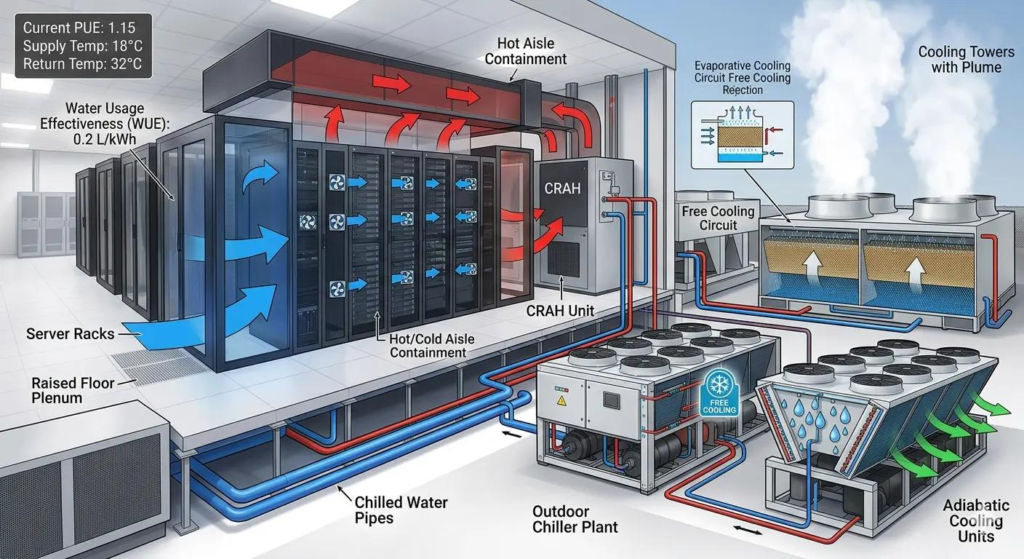
How Data Centers Cool AI Servers
There isn’t one universal cooling method.
Modern data centers can use several approaches.
Air cooling
Air is circulated through the facility to remove heat.
It can be relatively simple, but extremely high-density AI hardware can make traditional air cooling challenging.
Evaporative cooling
Water is evaporated to remove heat.
This can be efficient but consumes water.
Liquid cooling
Liquid is brought closer to the heat-producing components.
This can provide efficient heat removal for high-performance AI systems.
Direct-to-chip cooling
A liquid coolant is circulated through components or cold plates positioned directly against high-heat chips.
Closed-loop systems
The same cooling liquid can be continuously circulated rather than constantly consuming fresh water.
This is increasingly important as AI servers become more powerful.
Are New AI Data Centers Using Less Water?
In some cases, yes.
The industry is investing in more efficient cooling technologies.
For example, the U.S. Department of Energy notes that closed-loop systems can significantly reduce water consumption compared with traditional evaporative cooling.
Microsoft also says it is reducing freshwater demand at data centers through facility designs and regional water projects, including rainwater harvesting initiatives.
This illustrates an important point:
The water footprint of AI is changing as the underlying infrastructure changes.
Older estimates should therefore not automatically be applied to every AI system operating today.
AI’s Water Footprint Depends on Location
Where an AI model runs can matter almost as much as what model is being used.
Imagine two identical AI servers.
One operates in a cool region with abundant renewable electricity and an efficient low-water cooling system.
Another operates in a hot, water-stressed region using an evaporative cooling system and an electricity grid with a higher water intensity.
The two servers could have very different environmental footprints.
The researchers behind the “Making AI Less Thirsty” study specifically found significant spatial and temporal differences in AI water efficiency.
In other words:
When and where AI runs can influence how much water it indirectly requires.
Why AI Data Centers Are Growing So Quickly
The demand for AI computing has exploded.
AI models are becoming larger and more capable, while millions of people and businesses are incorporating AI into their daily workflows.
This means data centers need more powerful hardware.
The International Energy Agency reported that global data-center electricity consumption reached approximately 415 TWh in 2024, representing around 1.5% of global electricity consumption. Its base-case projection has data-center electricity consumption reaching around 945 TWh by 2030.
The IEA’s 2026 update also found that electricity consumption from AI-focused data centers grew particularly quickly in 2025.
This matters for water because energy demand and cooling requirements are closely connected.
How Much Water Could AI Use in the Future?
Researchers have attempted to estimate the future water footprint of AI.
The “Making AI Less Thirsty” research projected that global AI demand could account for approximately 4.2–6.6 billion cubic meters of water withdrawal in 2027, while estimated water consumption was around 0.38–0.60 billion cubic meters under the study’s assumptions.
These are projections rather than measurements of today’s actual global AI water use.
Future numbers can change substantially depending on:
- AI adoption
- Model efficiency
- Hardware improvements
- Cooling technology
- Data-center locations
- Electricity sources
- Water recycling
- AI workload types
- Regulatory requirements
Therefore, these figures should be treated as scenario estimates rather than a guaranteed future amount.
Google Is Investing in Water Replenishment
Large technology companies are increasingly reporting their water footprints and investing in water stewardship.
Google’s environmental reporting says that in 2025 it replenished approximately 7.7 billion gallons of water, equivalent to around 78% of its total freshwater consumption for that year.
Google has also reported major improvements in the efficiency of its AI hardware.
Its 2025 environmental report said its Ironwood TPU was nearly 30 times more power efficient than Google’s first Cloud TPU.
Better hardware efficiency can matter because using less energy for the same AI workload can potentially reduce associated cooling and water requirements.
Does AI Use More Water Than Traditional Computing?
It depends on the workload.
AI is not the only thing operating inside data centers.
Data centers also run:
- Websites
- Cloud storage
- Streaming services
- Databases
- Business applications
- Online games
- Search engines
- Traditional software
What makes modern AI particularly important is the rapidly increasing computational intensity of some AI workloads.
Large AI models require powerful accelerators and can create high-density heat loads.
The IEA notes that AI-focused data centers can have power requirements comparable to very large industrial facilities.
Therefore, AI can increase the infrastructure requirements associated with data centers, although the exact water impact depends heavily on implementation.
Is AI Water Consumption Bad for the Environment?
It can be.
But the answer requires some nuance.
Water consumption becomes especially concerning when data centers are built in areas already experiencing water stress.
A data center might have relatively efficient cooling technology but still create local concerns if its water demand competes with:
- Drinking water
- Agriculture
- Ecosystems
- Industrial users
- Local communities
This is why location matters.
The environmental impact of AI should not be evaluated solely by asking how many liters are used globally.
We should also ask:
Where is the water coming from?
Is the water potable?
Is it recycled?
Is the region experiencing water stress?
How much water is actually consumed rather than withdrawn?
These questions provide a much better picture.
Can AI Become More Water Efficient?
Yes.
There are several ways to reduce AI’s water footprint.
1. More efficient AI models
If models can produce the same result using fewer computations, they require less electricity and potentially less cooling.
2. Better AI chips
More efficient GPUs, TPUs and other accelerators can perform more computation per unit of electricity.
3. Better cooling
Liquid cooling and closed-loop systems can reduce reliance on evaporative cooling.
4. Recycled water
Data centers can use reclaimed or recycled water instead of relying entirely on potable freshwater.
5. Better site selection
Companies can locate facilities in regions where water and electricity systems are more suitable for data-center operations.
6. Renewable electricity
Renewable energy can reduce some indirect environmental impacts associated with electricity generation, although renewable power does not automatically mean zero water footprint.
7. Smarter scheduling
AI workloads can potentially be shifted toward locations or times when water efficiency is better.
The research literature specifically discusses choosing the time and location of AI workloads as a potential method for reducing water consumption.
Does Using AI Personally Waste Water?
A single person’s AI use is generally tiny compared with the total water use of an entire data center.
The bigger issue is scale.
Imagine millions or billions of AI requests being processed.
Even a relatively small amount of water associated with one request can become significant when multiplied across enormous volumes of computation.
This is similar to electricity consumption.
One phone charger does not consume a huge amount of electricity.
But billions of devices operating around the world create a substantial energy demand.
The same principle applies to AI infrastructure.
What About AI Image and Video Generation?
Text generation is not the only form of AI.
AI image and video generation can require significantly more computation than a simple text response.
A system might need to generate thousands or millions of numerical calculations to create an image.
Video generation can be even more computationally demanding because the system must generate or process many frames.
Therefore, it would be misleading to assume that:
1 AI image = 1 AI text request
or:
1 AI video = 1 AI text request
The workloads can be dramatically different.
The IEA’s 2026 analysis highlights that newer energy-intensive applications, including video generation and agentic AI, can consume much more energy per task than simple text generation.
What About AI Search?
AI-powered search can combine several computational processes.
For example, a system might:
- Receive the user’s question
- Search information
- Retrieve documents
- Process the information
- Generate an answer
- Potentially perform additional reasoning
The water footprint depends on the infrastructure and amount of computation involved.
Therefore, it is difficult to give one universal number for “one AI search.”
How Does AI Compare With Other Everyday Activities?
Comparisons can be useful, but they can also be misleading.
For example, you may see headlines comparing AI water use to:
- Bottles of drinking water
- Cups of coffee
- Almonds
- Showers
- Washing machines
The problem is that these comparisons may use different definitions of water consumption.
One calculation might include indirect water associated with electricity.
Another might count only direct cooling.
Another might include manufacturing.
So before comparing two activities, you should ask:
Are they measuring the same type of water footprint?
Without that context, a comparison can create a false impression.
Is the Claim “AI Uses a Bottle of Water Per Question” True?
Not as a universal rule.
This is one of the most important points to understand.
Academic research has produced estimates in that general range under specific conditions and assumptions, but that does not mean every AI question consumes a bottle of water.
The famous estimate associated with GPT-3 was based on a specific model and deployment scenario. The study estimated approximately 500 mL for 10–50 medium-length responses, depending on the location and time of deployment.
Newer AI infrastructure may use substantially different cooling technologies and hardware.
Therefore, the safest answer is:
AI has a real water footprint, but there is no universal amount of water used per AI question.
Why We Need Better AI Water-Use Transparency
One of the biggest challenges is that users usually don’t know exactly how much water is associated with their AI requests.
AI companies generally provide information about:
- Model capabilities
- Performance
- Speed
- Cost
- Safety
But detailed workload-level water information is much less standardized.
Researchers have argued for greater transparency around AI’s water footprint, including information about operational efficiency.
More transparent reporting could eventually allow users and businesses to understand:
How much energy did this AI task require?
How much water was consumed?
Where was the computation performed?
What type of cooling system was used?
How much water was recycled?
Such information would make environmental comparisons much more meaningful.
AI Water Consumption: Key Numbers at a Glance
| Question | What we know |
|---|---|
| Does AI use water? | Yes, directly and indirectly |
| Does every AI query use the same amount? | No |
| Does AI use water for cooling? | Often, depending on the cooling system |
| Does electricity production have a water footprint? | Yes, depending on the power source |
| Does AI chip manufacturing use water? | Yes |
| Did GPT-3 training have a large estimated water footprint? | Yes |
| Estimated total GPT-3 training water in one major study | About 5.4 million liters |
| Estimated direct on-site GPT-3 training water | About 700,000 liters |
| Is 500 mL per AI response a universal rule? | No |
| Can modern cooling reduce water use? | Yes |
| Does location affect water use? | Significantly |
| Is AI water use expected to become an issue as AI scales? | Yes |
The GPT-3 figures above come from the published “Making AI Less Thirsty” research and should not be treated as measurements for every current AI model.
How Much Water Does AI Use Per Day?
There is currently no reliable single global figure that can tell us exactly how many liters of water all AI systems consume every day.
Why?
Because the global AI ecosystem includes thousands of:
- Data centers
- AI models
- Cloud providers
- Private systems
- Enterprise deployments
- AI applications
- Hardware configurations
And companies do not all report water consumption in the same way.
Furthermore, separating AI workloads from other data-center workloads can be difficult.
As AI becomes a larger portion of data-center computing, however, researchers and regulators are paying more attention to the issue.
The Future of AI and Water
AI’s water footprint is likely to become an increasingly important environmental topic.
There are two forces moving in opposite directions.
Efficiency is improving
AI hardware and software are becoming more efficient.
The amount of energy required for individual AI tasks can fall dramatically as hardware and algorithms improve.
The IEA’s 2026 analysis found that energy use per individual AI task has been declining rapidly.
AI usage is growing
At the same time, more people are using AI.
Companies are adding AI agents, image generation, video generation, reasoning models and other computationally intensive services.
So even if each individual task becomes more efficient, total resource consumption can still increase if usage grows faster than efficiency improves.
This is sometimes described as an efficiency-versus-demand challenge.
Can AI Actually Help Save Water?
Interestingly, yes.
AI can also be used to reduce water consumption in other industries.
For example, AI can help with:
- Agricultural irrigation
- Leak detection
- Water-quality monitoring
- Weather forecasting
- Reservoir management
- Wastewater treatment
- Industrial optimization
- Flood prediction
Google says its flood forecasting technology has expanded to cover more than two billion people across approximately 150 countries.
So the environmental question isn’t simply whether AI uses water.
A better question is:
Does the value created by AI justify and outweigh the environmental resources required to operate it?
That answer can vary by application.
What Can AI Companies Do to Reduce Water Use?
Technology companies can take several steps.
Build data centers with low-water cooling
Closed-loop and other advanced cooling technologies can significantly reduce freshwater requirements.
Use reclaimed water
Using treated wastewater instead of drinking-quality water can reduce pressure on local freshwater supplies.
Improve hardware efficiency
More efficient chips can reduce energy and cooling requirements.
Increase transparency
Companies can publish water consumption data alongside energy and carbon metrics.
Avoid water-stressed locations
Data centers should consider local water availability before construction.
Replenish water
Companies can invest in watershed restoration and other projects that help replenish freshwater resources.
Google, for example, reports substantial investments in water replenishment projects.
What Can AI Users Do?
Individual users have much less influence than infrastructure operators, but there are still sensible practices.
You don’t need to stop using AI completely because of water concerns.
Instead:
- Use AI when it provides meaningful value.
- Avoid unnecessary repeated generations.
- Use smaller models when they are sufficient.
- Avoid generating dozens of images when one is enough.
- Consider the computational intensity of large video-generation tasks.
- Support companies that publish environmental data.
- Pay attention to sustainability claims rather than viral statistics.
The goal isn’t necessarily to eliminate AI use.
The goal is to make AI more efficient and environmentally responsible.
Frequently Asked Questions
How much water does AI use?
There is no single number. AI’s water footprint depends on the model, hardware, data center, cooling system, electricity source, location and measurement method.
Does ChatGPT use water?
AI services such as ChatGPT run on computing infrastructure that requires electricity and cooling. That infrastructure can have a water footprint. However, the exact water use per individual current ChatGPT request is not a universal publicly established number.
Does one AI question use a bottle of water?
No universal rule says that one AI question consumes a bottle of water. A widely cited academic study estimated about 500 mL for roughly 10–50 medium-length GPT-3 responses under particular deployment conditions.
How much water did GPT-3 training use?
One published study estimated approximately 5.4 million liters of total water consumption for GPT-3 training under its modeled conditions, including approximately 700,000 liters of direct on-site water consumption.
Why does AI need water?
Primarily because servers produce heat and some data centers use water-based cooling systems. Water can also be associated with electricity generation and semiconductor manufacturing.
Does AI use more water than Google searches?
There is no simple universal comparison because different searches and AI tasks require different amounts of computing, and water-footprint calculations can include different categories.
Does AI image generation use more water than text generation?
It can have a larger environmental footprint because image generation can require more computation than a simple text request. However, the exact difference depends on the model, hardware and workload.
Does AI video generation use a lot of water?
Potentially. Video generation can require substantially more computation than simple text generation, which can increase its associated energy and cooling requirements.
Can AI data centers operate without using much water?
Yes. Some modern facilities use technologies such as closed-loop cooling and other low-water approaches. However, the total water footprint can still include indirect water associated with electricity and manufacturing.
Is AI bad for the environment?
AI has environmental costs, including energy and water consumption, hardware manufacturing and emissions. At the same time, AI can potentially help reduce resource use in areas such as energy management, agriculture, transportation and water management.
Will AI water consumption increase?
It could increase in total as AI adoption expands, even while individual AI tasks become more efficient. Future water use will depend heavily on hardware efficiency, cooling technology, data-center locations and electricity sources.
Final Thoughts: How Much Water Does AI Really Use?
The simplest answer is:
AI does use water, but there is no single number that accurately describes how much water every AI request consumes.
The water footprint of AI comes from several layers of infrastructure.
There is the water used to cool servers.
There is water associated with producing electricity.
And there is water used throughout the supply chain, including semiconductor manufacturing.
Older studies have demonstrated that large AI models can have surprisingly large water footprints. For example, one peer-reviewed analysis estimated that GPT-3 training could consume around 5.4 million liters of water when both direct and indirect operational water were considered.
But AI infrastructure is changing rapidly.
Modern chips are becoming more efficient. Cooling systems are improving. Some data centers are moving toward closed-loop systems. Companies are investing in water replenishment and conservation.
At the same time, AI usage is growing extremely quickly.
That means the important question isn’t simply:
“Does AI use water?”
It clearly does.
The more important questions are:
How much water does a particular AI workload use?
Where does that water come from?
How much is actually consumed?
How much can be recycled?
And can AI become efficient enough that its benefits outweigh its environmental footprint?
As artificial intelligence continues to expand, water efficiency is likely to become just as important to sustainable AI as energy efficiency and carbon emissions.